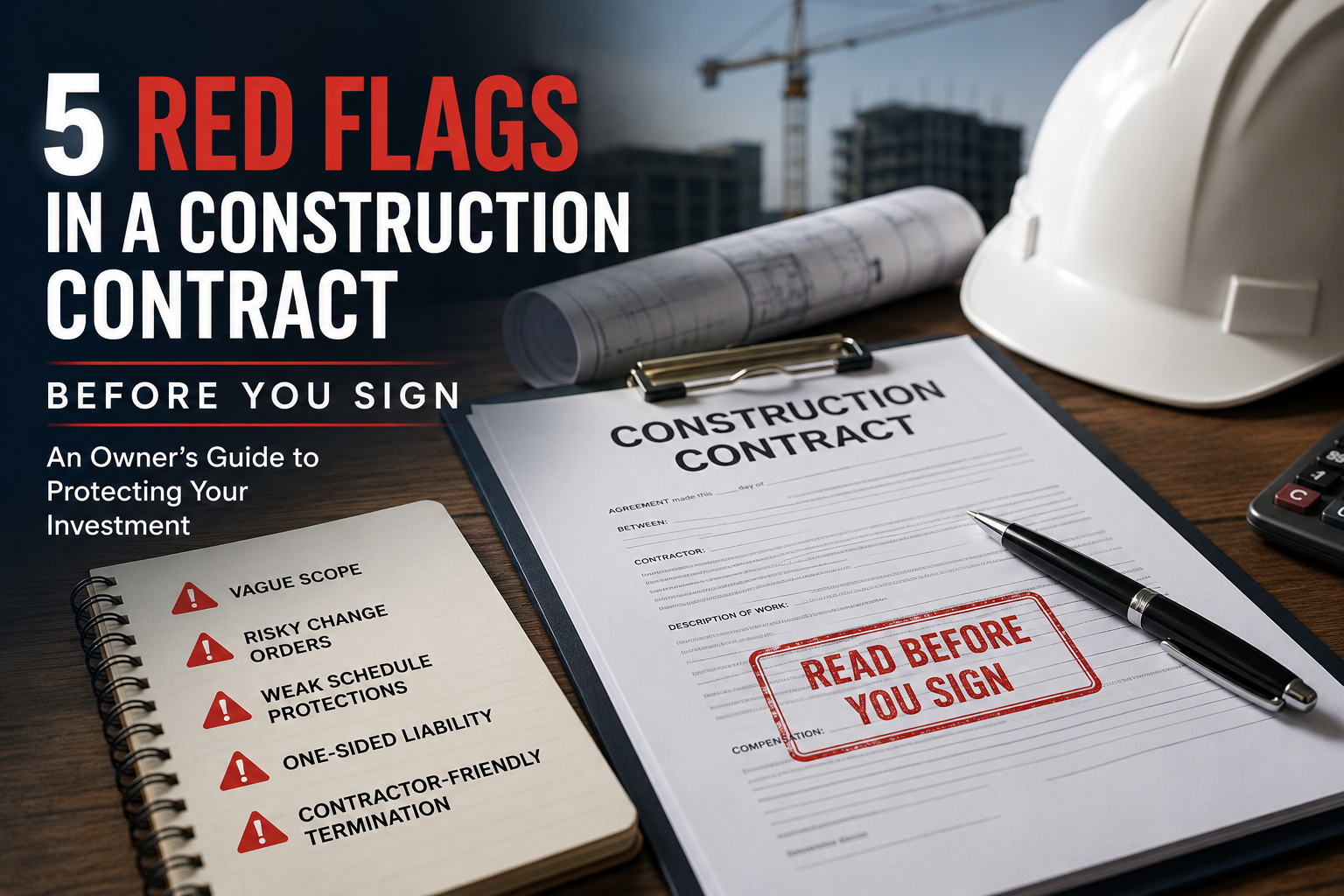
5 Construction Contract Red Flags Owners Should Catch Before Signing
Construction contracts are designed to allocate risk, define responsibilities, and establish expectations for everyone involved in a project. Unfortunately, many owners sign contracts without fully understanding provisions that can lead to budget overruns, project delays, unexpected liability, and costly disputes.
Before signing a construction contract, owners should carefully review the agreement for provisions that disproportionately favor the contractor or limit the owner's ability to control the project. Below are five of the most common construction contract red flags every owner should understand.
1. Vague or Incomplete Scope of Work
One of the most dangerous issues in any construction contract is a poorly defined scope of work. If the contract does not clearly describe the work the contractor is obligated to perform, disputes are almost inevitable.
When scope language is vague, contractors may argue that certain work was not included in the original contract price and should be treated as additional work. This can result in unexpected change orders, increased costs, and disagreements about project completion.
Owners should ensure the contract:
- Incorporates plans, specifications, and drawings by reference.
- Clearly identifies all work included in the contract price.
- Requires the contractor to perform work reasonably inferable from the contract documents.
- Eliminates ambiguity regarding responsibilities and deliverables.
A detailed scope of work is one of the strongest protections an owner can have during a construction project.
2. Unfavorable Change Order Provisions
Changes are common in construction, but poorly drafted change order provisions can create significant financial risk for owners.
Red flags include provisions that:
- Allow the contractor to determine pricing unilaterally.
- Do not require supporting documentation for additional costs.
- Permit excessive markups on labor, materials, or subcontractor work.
- Allow the contractor to suspend work while pricing disputes are resolved.
A well-drafted construction contract should establish a clear change order process that requires written approval, detailed cost breakdowns, and agreed-upon markup percentages.
The contract should also require the contractor to continue working while change order pricing disputes are being resolved. This helps avoid project delays and keeps the project moving forward.
3. Weak Schedule Protections and No Meaningful Delay Remedies
Time delays can be extremely expensive for owners. Extended construction schedules often result in additional financing costs, lost revenue, delayed occupancy, and increased carrying expenses.
A major red flag is a contract that lacks meaningful schedule enforcement provisions.
Owners should be cautious when a contract:
- Does not contain a guaranteed completion date.
- Omits milestone deadlines.
- Fails to include liquidated damages for late completion.
- Provides broad excuses for delay through expansive force majeure language.
While legitimate delays can occur, owners should negotiate reasonable schedule protections that hold contractors accountable.
Effective contracts typically include:
- Defined milestone dates.
- A substantial completion deadline.
- Liquidated damages provisions.
- Narrowly tailored excusable delay provisions.
These provisions help ensure the contractor remains focused on timely completion.
4. One-Sided Indemnification and Limitation of Liability Clauses
Risk allocation provisions are among the most important terms in a construction contract.
Owners should carefully review indemnification and limitation of liability clauses to ensure the contractor remains responsible for its own mistakes.
Potential red flags include:
- Liability caps that are significantly lower than the contract value.
- Contractor exclusions for consequential damages without a reciprocal owner benefit.
- Narrow indemnity provisions that exclude property damage.
- Indemnification language that only applies to bodily injury claims.
If defective work causes substantial damage, a poorly drafted limitation of liability clause can leave the owner without an adequate remedy.
Owners should seek provisions that:
- Require the contractor to indemnify the owner for losses caused by contractor negligence.
- Cover both bodily injury and property damage claims.
- Establish commercially reasonable liability limits.
- Allocate risk fairly between the parties.
Understanding these provisions before signing can prevent significant financial exposure later.
5. Termination Provisions That Favor the Contractor
Every owner should retain the ability to terminate a construction contract when circumstances require it.
A balanced contract should include termination rights for both cause and convenience.
Warning signs include provisions that:
- Require excessive notice procedures.
- Impose lengthy cure periods.
- Award the contractor lost profits on unperformed work.
- Make it difficult for the owner to establish contractor default.
- Automatically convert a termination for cause into a termination for convenience.
Owners should negotiate termination clauses that allow them to protect their interests if the contractor fails to perform.
A properly drafted termination provision should:
- Clearly define contractor default.
- Allow termination for convenience upon reasonable notice.
- Limit payment to work actually performed and materials properly procured.
- Preserve the owner's remedies for contractor breaches.
These protections provide owners with leverage and flexibility when projects do not proceed as planned.
Final Thoughts
Construction contracts establish the framework for every successful project. Before signing, owners should carefully review the agreement for vague scope language, problematic change order provisions, weak schedule protections, unfair liability limitations, and contractor-friendly termination clauses.
Identifying and addressing these issues before execution is far less expensive than litigating disputes after construction begins.
A thorough contract review by experienced construction counsel can help owners avoid costly mistakes, preserve negotiating leverage, and protect their investment throughout the life of the project.
Get the Free Construction Contract
Red Flags Checklist!