AIA A101 vs. A105: Which AIA Contract Is Best for Residential Construction Projects? (2026 Guide)
Introduction
Every residential contractor eventually faces the same question:
Should I use the AIA A101 or the AIA A105?
While both contracts establish the relationship between an owner and contractor, they were designed for very different project types. Choosing the wrong agreement can create unnecessary administrative burdens, increase risk, and lead to confusion when disputes arise.
In this guide, we'll explain the key differences between AIA A101 and A105 contracts, compare their strengths and weaknesses, and provide practical examples to help builders choose the right document for their next project.
What Is the AIA A101 Contract?
The AIA A101 is designed for larger, more complex projects where a stipulated sum (fixed price) arrangement is used and where the parties anticipate incorporating the full suite of AIA general conditions found in AIA A201 (General Conditions of the Contract for Construction). Together, the A101 and A201 form a comprehensive contractual framework that addresses virtually every aspect of the construction relationship. The A101 itself focuses on the business terms — the contract sum, the schedule of values, progress payments, and the timeline for substantial completion — while the A201 supplies roughly sixty pages of general conditions covering topics such as the architect's administration of the contract, the contractor's responsibilities, subcontractual relations, changes in the work, claims and disputes, insurance, bonds, and termination.
The A101 is best suited for projects with significant budgets, multiple subcontractors, and extended timelines where comprehensive contractual protections are warranted. It presupposes that an architect will serve as the initial decision-maker on claims and disputes between the owner and the contractor, and it contains detailed mechanisms for processing change orders, handling concealed or unknown conditions, and managing the close-out process.
What Is the AIA A105 Contract?
The AIA A105, by contrast, is a shorter-form agreement intended for smaller, less complex projects. It incorporates its own general conditions within the document itself rather than requiring a separate A201 attachment. This streamlined format — typically running around fifteen pages in total — reduces paperwork and negotiation time, making it well suited for modest residential renovations, additions, or new builds where the scope and risk profile do not justify the administrative overhead of the full A101/A201 pairing. The A105 still addresses core topics such as the contract sum, the schedule of the work, payment terms, insurance, changes in the work, and dispute resolution, but it does so in a condensed manner and with fewer procedural layers.
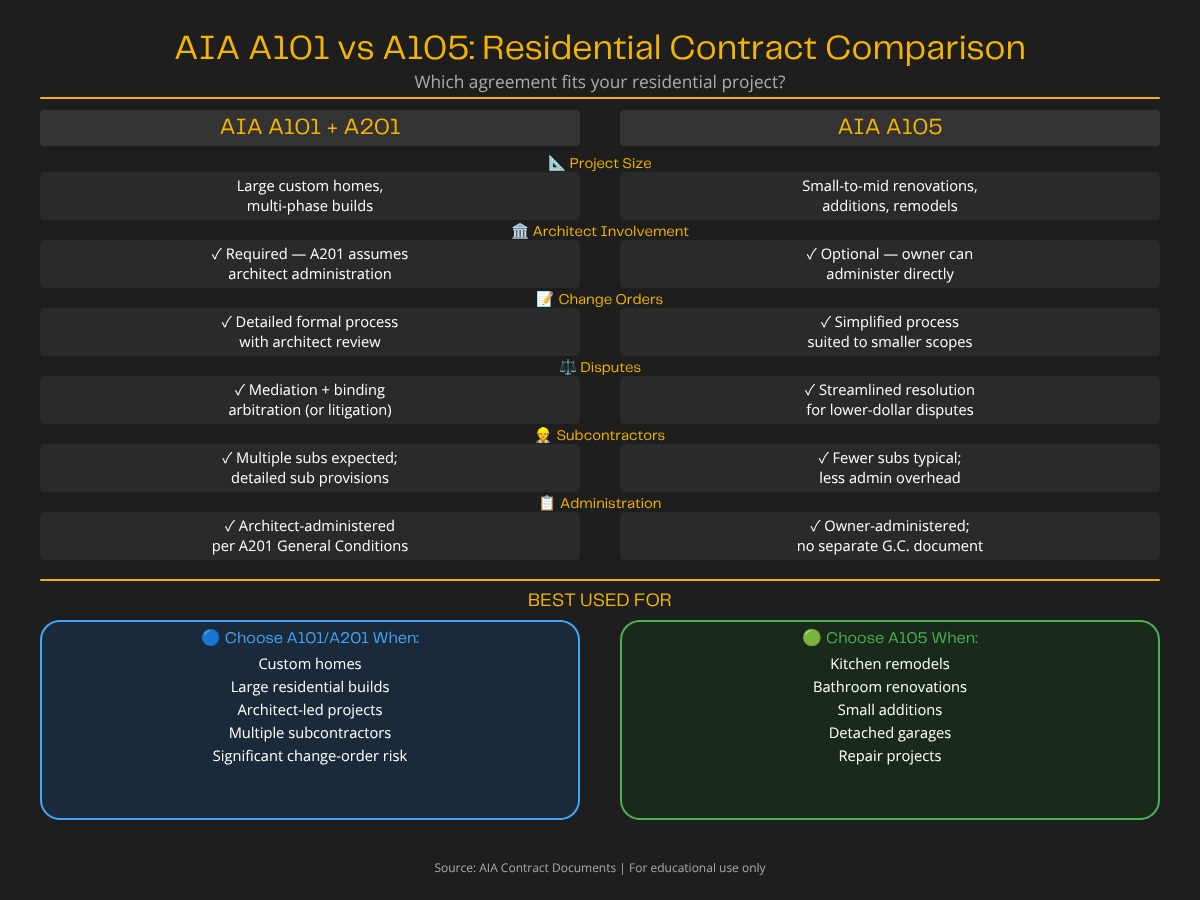
AIA A101 vs A105: Side-by-Side Comparison
When Should Residential Contractors Use AIA A105?
Kitchen and Bathroom Renovation:
Consider a homeowner who hires a residential contractor to remodel a kitchen and two bathrooms in an existing single-family home. The project budget is approximately $75,000, the work is expected to take eight to ten weeks, and the homeowner has not retained an architect for contract administration (though an architect may have prepared the design drawings). The contractor will self-perform some of the work and engage a plumber, an electrician, and a tile installer as subcontractors.
In this scenario, the AIA A105 is almost certainly the right choice. The project scope is well defined, the budget is modest, and the administrative overhead of the full A101/A201 package would be disproportionate to the size of the job. The A105 gives both parties a clear, professionally drafted agreement that covers the essential terms — price, schedule, payment, changes, and disputes — without burdening them with sixty pages of general conditions that were written with much larger projects in mind. The homeowner benefits from a document that is easier to read and understand, and the contractor benefits from a streamlined administrative process that lets the team focus on the work itself.
Emergency Repair or Small Addition:
Consider a small-scale engagement: a homeowner needs a contractor to repair storm damage to a roof and rebuild a damaged porch, with a total budget of around $30,000 and a timeline of three to four weeks. There is no architect involved, and the contractor will handle the work with one or two subcontractors at most.
The A105 is the clear choice here, and even the A105 may feel somewhat formal for a project of this size. Nevertheless, using a standardized AIA agreement — even the short form — is far preferable to relying on a handshake or a one-page proposal letter. The A105 ensures that both parties have a shared understanding of the price, the scope, the payment schedule, and their respective obligations, which reduces the risk of disputes and provides a framework for resolving them if they arise.
Ideal for:
- Kitchen renovations
- Bathroom remodels
- Small additions
- Storm damage repairs
- Projects under $250,000
When Should Residential Contractors Use AIA A101?
Custom Home Build:
Now consider a different scenario: a homeowner engages a contractor to build a custom single-family residence from the ground up. The project budget is $1.2 million, the architect will remain involved throughout construction to administer the contract and review submittals and payment applications, and the contractor will coordinate a dozen or more subcontractors across multiple trades over a fourteen-month construction timeline.
Here, the AIA A101 paired with A201 is the stronger choice. The complexity of the project — phased construction, extensive subcontractor coordination, an architect actively administering the contract, and a substantial financial commitment — calls for the detailed provisions that only the A101/A201 combination provides. For instance, the A201 contains comprehensive change-order procedures that distinguish between Change Orders (agreed upon by the owner, architect, and contractor) and Construction Change Directives (which allow the owner and architect to direct changes even when the contractor has not yet agreed on cost or time adjustments). On a $1.2 million custom build, where unforeseen conditions and owner-requested changes are common, these procedural safeguards are invaluable. Similarly, the A201's detailed claims process — which requires the contractor to submit claims within twenty-one days of the event giving rise to the claim and routes initial decisions through the architect — provides a structured pathway for resolving disputes before they escalate to mediation or litigation.
Ideal for:
- Custom homes
- Luxury residences
- Architect-administered projects
- Complex multi-trade projects
- Projects exceeding $500,000
Gray Area Projects: When Either Contract May Work
A project in the middle range can be the most difficult to categorize. Suppose a homeowner hires a contractor to build a detached two-car garage with a finished accessory dwelling unit above it. The project budget is $250,000, the timeline is approximately six months, and the homeowner's architect will review submittals but will not serve as a full-time contract administrator.
This is a judgment call, and reasonable contractors could go either way. The A105 may be sufficient if the scope is clearly defined, the number of subcontractors is manageable, and both parties are comfortable with a streamlined set of terms. On the other hand, if the project involves complex structural work, significant mechanical and electrical systems for the dwelling unit, or if the homeowner is particularly sophisticated and wants robust change-order and dispute-resolution procedures, the A101/A201 package may be worth the added complexity. A practical middle ground that some contractors adopt is to start with the A105 and supplement it with additional provisions — such as a more detailed change-order clause or an expanded insurance schedule — tailored to the specific risks of the project.
Five Questions Contractors Should Ask Before Choosing A101 or A105
- Is an architect administering the project?
- How large is the budget?
- How many subcontractors are involved?
- How likely are change orders?
- How sophisticated is the owner?
Frequently Asked Questions
Is AIA A105 good for custom homes?
Generally no. Larger custom homes often benefit from the more comprehensive protections contained in A101 and A201.
Does AIA A105 include general conditions?
Yes. Unlike A101, the A105 includes its general conditions within the document itself.
Does AIA A101 require A201?
Typically yes. Most parties use A101 together with A201.
Which contract is easier for homeowners to understand?
A105 is generally more user-friendly because it combines the contract and general conditions into a single document.
Final Thoughts
For most residential remodelers and small builders, AIA A105 will be the better fit because it balances legal protection with simplicity.
However, when projects become larger, more complex, or architect-driven, the AIA A101 paired with A201 provides a more robust framework for managing risk, changes, and disputes.
The right contract depends on the project—not just the contract price.
Related Articles
- AIA A201 Explained for Residential Builders
- What Is a Construction Change Directive?
- How Written Change Orders Protect Contractors
- Top Contract Clauses Residential Builders Should Negotiate
- Fixed Price vs Cost Plus Construction Contracts
Need Help Identifying Contract Risks Before You Sign?
Understanding which AIA agreement to use is only one part of protecting your business. Contractors also need to evaluate payment provisions, change order requirements, indemnity clauses, notice provisions, dispute resolution terms, and dozens of other contract risks that can significantly impact profitability.
The Subcontractor Contract Toolkit from The Construction Contracts Guy provides practical checklists, risk-spotting tools, and contract review resources designed to help construction professionals identify common problem areas before signing.
Educational resources only. Not legal advice.
Get the Free Construction Contract
Red Flags Checklist!