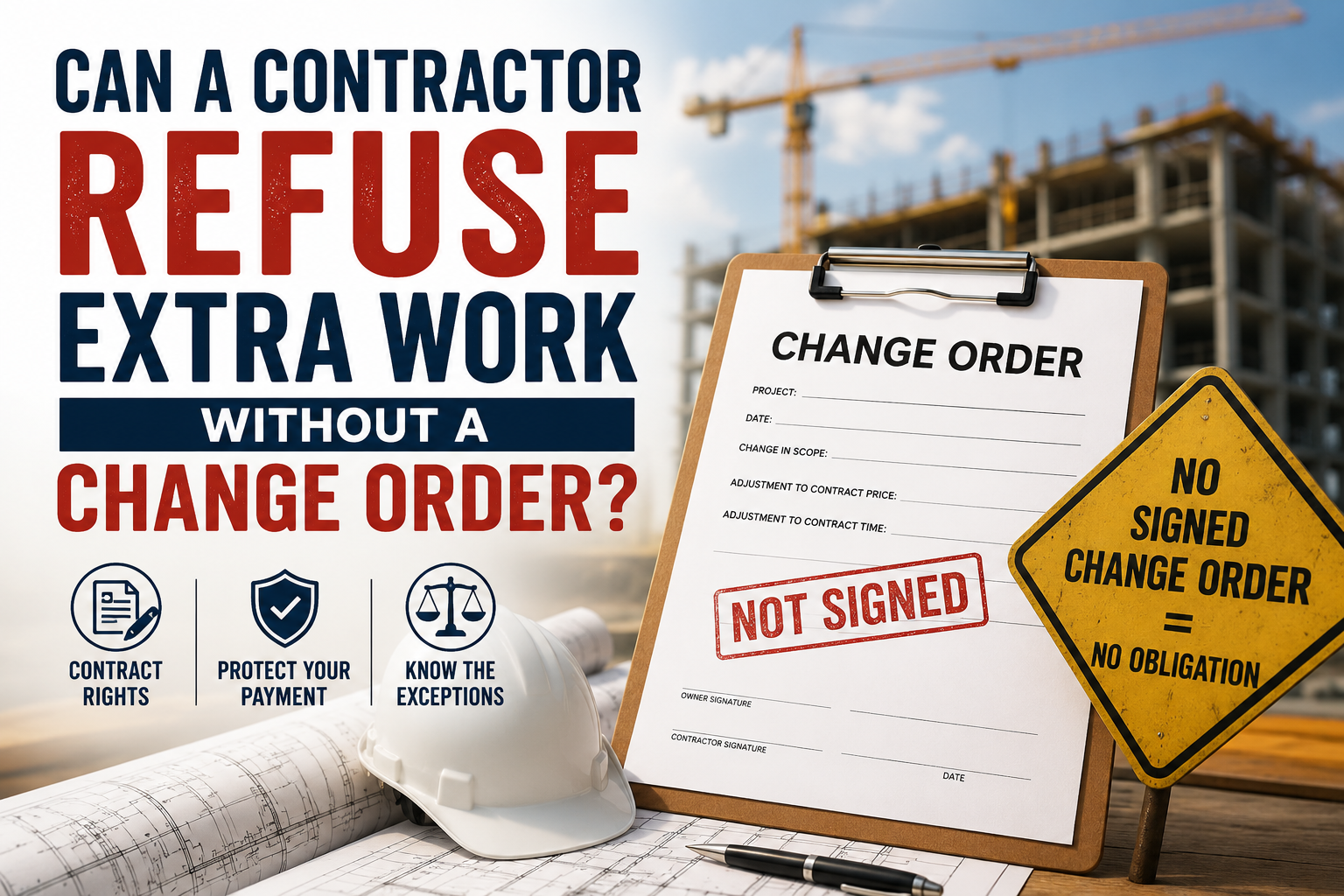
Can a Contractor Refuse Extra Work Without a Change Order?
In construction projects, disputes over extra work are among the most common sources of conflict between owners, contractors, and subcontractors. A question that frequently arises is whether a contractor can refuse to perform additional work when there is no signed change order.
The short answer is usually yes. In most circumstances, a contractor has the right to refuse work that falls outside the original contract scope until the parties agree on a written change order. However, several important exceptions can affect that right, including constructive changes, emergency work, duty-to-proceed clauses, and prior course of dealing between the parties.
Understanding when a contractor may refuse extra work—and when refusing may create legal risk—is essential for protecting payment rights and avoiding costly disputes.
What Is a Change Order?
A change order is a written document that modifies the original construction contract. Change orders typically address one or more of the following:
- Additional or reduced scope of work
- Changes to the contract price
- Extensions or reductions in project duration
- Modifications to project specifications
Virtually every standard construction contract includes a process for approving and documenting changes. Whether the contract is based on AIA, ConsensusDocs, EJCDC, or a custom form, written change order procedures exist to protect both parties.
The owner receives certainty regarding cost and schedule impacts, while the contractor gains assurance that it will be compensated for work beyond the original agreement.
Why Construction Contracts Require Written Change Orders
Construction contracts are based on a simple legal principle: each party is only obligated to perform what it agreed to in the contract.
When a contractor agrees to build a project for a specific price and within a specific timeframe, that agreement does not automatically include additional work requested later. Any request that expands the scope of work is generally considered a contract modification.
Most contracts require:
- A written request for a change.
- A proposal identifying cost and schedule impacts.
- A signed change order before the work begins.
Many contracts further state that contractors are not entitled to payment for extra work performed without prior written authorization.
Because of these provisions, contractors who proceed without a signed change order often assume significant payment risk.
Can a Contractor Legally Refuse Extra Work Without a Signed Change Order?
Generally, yes.
A contractor's obligation is to perform the work described in the contract documents for the agreed-upon price. Work outside that scope is not part of the contractor's original bargain.
For example, imagine a contractor is constructing a commercial office building. The owner requests upgraded marble flooring instead of the ceramic tile specified in the plans. The contractor submits pricing for the upgrade, but no change order is signed.
In that situation, the contractor is generally entitled to refuse the upgrade until the parties execute a written change order addressing:
- Additional cost
- Material procurement
- Schedule impacts
- Payment terms
Without a signed change order, the contractor risks performing work that may later become the subject of a payment dispute.
The same principle applies to subcontractors. If a general contractor directs additional work beyond the subcontract scope without issuing a change order, the subcontractor may often refuse that work until proper authorization is provided.
Exceptions to the Change Order Requirement
While contractors generally have the right to refuse unauthorized extra work, several important exceptions can complicate the analysis.
Constructive Change Orders
Many courts recognize the doctrine of constructive changes.
A constructive change occurs when an owner or contractor effectively requires additional work without formally issuing a written change order. Examples include:
- Verbal directives
- Rejection of compliant work
- Interpretation of specifications beyond their intended scope
- Requiring additional work not shown in the plans
In these situations, a contractor may still be entitled to compensation despite the lack of a signed change order.
However, constructive change claims typically arise after the work has been performed. They are generally not used to force a contractor to begin work it has not yet undertaken.
Emergency and Safety-Related Work
Many contracts contain provisions requiring immediate action during emergencies.
Examples include:
- Structural failures
- Safety hazards
- Flooding or water intrusion
- Conditions threatening life or property
Under these provisions, contractors may be required to proceed immediately, with the paperwork to follow later.
Refusing emergency work that is expressly required by the contract could expose a contractor to claims of breach of contract.
Duty-to-Proceed Clauses
One of the most significant exceptions is the duty-to-proceed clause.
These provisions require contractors to continue performing disputed work while preserving their right to seek additional compensation later.
For example, an owner may direct installation of a drainage system that the contractor believes falls outside the contract scope. The owner disagrees and insists the work is already required.
If the contract contains a duty-to-proceed provision, the contractor may be required to perform the work under protest while pursuing a claim through the contract's dispute resolution procedures.
Simply refusing the work could create liability if the contract requires continued performance.
Waiver Through Course of Dealing
Contractors should also be cautious when they have repeatedly performed extra work without signed change orders in the past.
If the parties consistently operate outside the written change order process and payments are routinely made afterward, a court may find that the parties effectively waived strict compliance with the contract requirements.
Although a contractor can usually insist on written change orders going forward, an established course of dealing can complicate the legal analysis and create leverage for the opposing party.
Best Practices for Contractors Facing Extra Work Requests
Even when a contractor has the legal right to refuse extra work, the business realities of construction projects often require a practical approach.
Put Everything in Writing
If an owner or general contractor requests additional work verbally, immediately follow up with written correspondence confirming:
- The request received
- Why the work falls outside the contract scope
- That a change order is required before proceeding
This creates a contemporaneous record that may become critical if a dispute arises later.
Submit Change Order Pricing Promptly
Responding quickly demonstrates professionalism and cooperation.
Delays in pricing extra work can be used against contractors and may increase project friction. Prompt proposals help move negotiations forward and reduce project disruption.
Understand Your Contract
Before refusing any work, carefully review:
- Change order provisions
- Claims procedures
- Notice requirements
- Duty-to-proceed clauses
- Dispute resolution requirements
A contractor's rights often depend on the specific language of the contract.
Best Practices for Owners and Developers
Owners benefit from following the change order process just as much as contractors.
Attempting to handle extra work through informal conversations often leads to disagreements over:
- Scope
- Pricing
- Schedule impacts
- Responsibility for delays
Instead, owners should:
- Issue written change requests
- Allow contractors to submit pricing
- Negotiate time impacts
- Execute formal change orders before authorizing work
Following the process reduces misunderstandings and minimizes the risk of litigation.
Frequently Asked Questions
Can a contractor refuse extra work without a signed change order?
Generally, yes. Contractors are typically only required to perform the work included within the original contract scope unless a contractual provision requires otherwise.
What happens if a contractor performs extra work without a change order?
The contractor may face significant challenges collecting payment if the owner later disputes the work or refuses to approve the associated costs.
What is a constructive change order?
A constructive change occurs when an owner's actions effectively require additional work despite the absence of a formal written change order.
What is a duty-to-proceed clause?
A duty-to-proceed clause requires contractors to continue performing disputed work while preserving their right to seek additional compensation through the contract's claims process.
Can verbal change orders be enforceable?
In some circumstances, yes. However, written change orders provide the strongest protection and significantly reduce the likelihood of disputes.
Conclusion
A contractor's right to refuse extra work without a signed change order is one of the most important protections found in construction contracts. Because contractors are generally obligated only to perform the work included within the agreed scope, additional work typically requires mutual approval and written authorization.
That said, contractors must remain aware of exceptions such as constructive changes, emergency directives, duty-to-proceed clauses, and waiver through prior conduct. Before refusing any requested work, contractors should carefully review their contracts and document their position in writing.
When owners and contractors respect the change order process, projects move more efficiently, payment disputes are reduced, and the risk of litigation decreases substantially.

Get the Free Construction Contract
Red Flags Checklist!