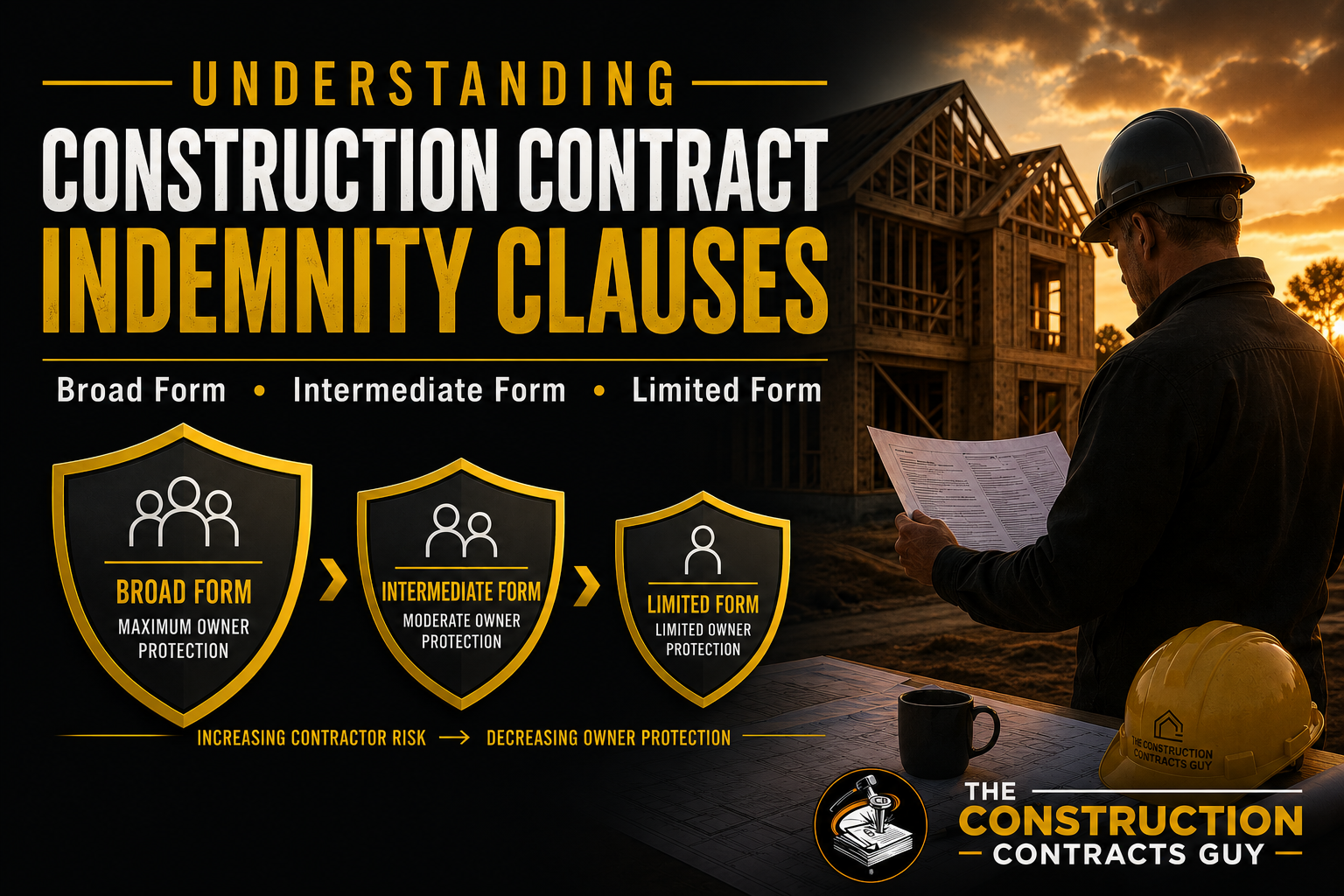
Construction Contract Indemnity Clauses Explained: Broad, Intermediate & Limited Form Indemnity
Construction contracts contain numerous risk-allocation provisions, but few are more important than the indemnity clause. A single indemnification provision can determine who pays for bodily injury claims, property damage, attorney's fees, and costly litigation when something goes wrong on a project.
For contractors, subcontractors, and property owners, understanding construction contract indemnity clauses is critical before signing any agreement.
In this guide, you'll learn:
- What an indemnity clause is
- The three primary levels of indemnity
- Common indemnity clause examples
- State anti-indemnity laws
- Insurance considerations
- Practical contract negotiation tips
What Is an Indemnity Clause in a Construction Contract?
An indemnity clause is a contractual provision requiring one party (the indemnitor) to compensate another party (the indemnitee) for certain losses, damages, liabilities, claims, or legal expenses arising from a construction project.
In construction contracts, indemnity provisions commonly allocate responsibility for:
- Bodily injury claims
- Property damage
- Third-party lawsuits
- Attorney's fees and defense costs
- Workplace accidents
- Insurance claims
The scope of an indemnity obligation depends entirely on the language used in the contract.
Generally, construction contract indemnity clauses fall into three categories:
- Broad Form Indemnity
- Intermediate Form Indemnity
- Limited Form Indemnity
Understanding the differences between these three approaches can help contractors and owners avoid significant financial exposure.
Broad Form Indemnity
What Is Broad Form Indemnity?
Broad form indemnity represents the most aggressive transfer of risk.
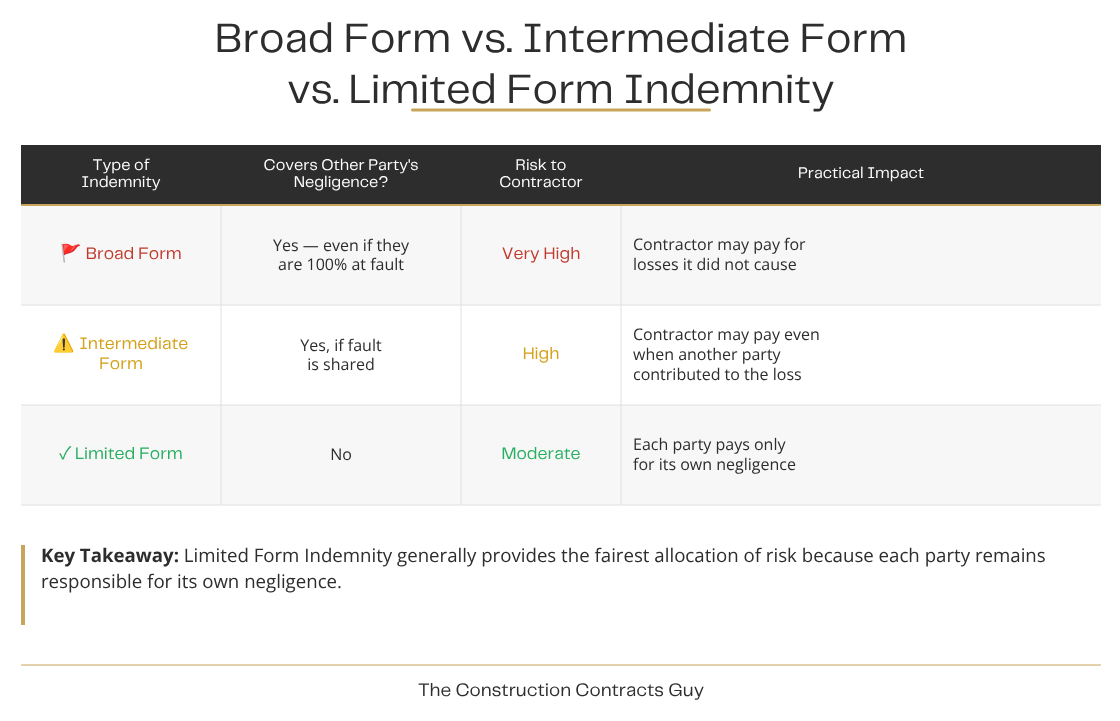
Under a broad form indemnity clause, the indemnitor agrees to protect the indemnitee from all losses arising out of or related to the project—even when the indemnitee is entirely responsible for the accident or damage.
In practical terms, this means a contractor or subcontractor could be required to pay for losses caused solely by another party's negligence.
Example of Broad Form Indemnity
Imagine a property owner hires an electrical contractor to perform work on a commercial building.
While the contractor is on site, the owner's employees negligently damage a gas line, causing an explosion that injures a bystander.
Even though the electrical contractor had nothing to do with the incident, a broad form indemnity provision could require the contractor to indemnify the owner for the resulting claims and damages.
Why Broad Form Indemnity Is Dangerous
Broad form indemnity can force a party to assume responsibility for losses it did not cause.
Because of this harsh result, many states have enacted anti-indemnity statutes that prohibit or restrict broad form indemnity provisions in construction contracts.
However, contractors should not rely solely on statutory protections. Even if a clause is ultimately unenforceable, litigation may be required to establish that fact.
Red Flag Language
Watch for phrases such as:
- "Regardless of cause"
- "Whether or not caused by the negligence of the indemnitee"
- "Any and all claims arising out of the work"
- "Without regard to fault"
These phrases often indicate a broad form indemnity obligation.
Intermediate Form Indemnity
What Is Intermediate Form Indemnity?
Intermediate form indemnity occupies the middle ground between broad and limited indemnity.
Under this approach, the indemnitor agrees to indemnify the indemnitee for losses arising from the project unless the indemnitee was solely negligent.
This means the indemnitor may be responsible even when the indemnitee contributed to the accident or loss.
Example of Intermediate Form Indemnity
Consider a roofing subcontractor working for a general contractor.
A worker is injured because:
- The subcontractor failed to install adequate fall protection.
- The general contractor failed to maintain safe site conditions.
Both parties share responsibility.
Under an intermediate form indemnity provision, the subcontractor could still be required to indemnify the general contractor for the entire claim because the general contractor was not solely at fault.
Risks of Intermediate Form Indemnity
Many contractors underestimate how much risk this language creates.
Even if another party contributes to an accident, the indemnitor may still bear most or all of the financial burden.
Before accepting intermediate form indemnity, contractors should review their insurance coverage carefully to determine whether their policies respond to contractual indemnity obligations of this scope.
Limited Form Indemnity
What Is Limited Form Indemnity?
Limited form indemnity is generally considered the fairest and most balanced approach.
Under a limited form indemnity clause, each party is responsible only for losses caused by its own negligence, acts, omissions, employees, agents, or subcontractors.
Responsibility follows fault.
Example of Limited Form Indemnity
Using the roofing example above:
- The subcontractor remains responsible for damages caused by its failure to provide fall protection.
- The general contractor remains responsible for damages caused by unsafe site conditions.
Liability is allocated according to each party's actual share of fault.
Why Contractors Prefer Limited Form Indemnity
Limited form indemnity offers several advantages:
- Fair allocation of risk
- Better alignment with insurance coverage
- Reduced exposure to another party's negligence
- Easier contract negotiations
- Lower likelihood of catastrophic losses
For most contractors and subcontractors, limited form indemnity should be the preferred negotiation position whenever possible.
Construction Contract Indemnity Clause Checklist
Before signing any construction contract, consider the following steps.
1. Read Every Indemnity Clause Carefully
Indemnity provisions are frequently buried within:
- General conditions
- Supplementary conditions
- Incorporated documents
- Master service agreements
- Exhibit packages
Never assume that a standard form contract contains balanced indemnity language.
2. Understand Your State's Anti-Indemnity Laws
Many states restrict certain forms of indemnity in construction contracts.
Some statutes prohibit only broad form indemnity, while others also limit intermediate form indemnity.
Understanding your state's laws can provide valuable leverage during contract negotiations.
3. Coordinate Indemnity Obligations With Insurance Coverage
One of the most common mistakes contractors make is agreeing to indemnity obligations that exceed their insurance coverage.
Before signing a contract:
- Review your commercial general liability policy
- Review additional insured requirements
- Discuss contractual indemnity obligations with your broker
- Confirm your policy responds to the risks being assumed
4. Negotiate When Necessary
Many owners and general contractors are willing to revise indemnity language when concerns are raised early in the negotiation process.
A reasonable revision before execution can prevent years of costly litigation later.
Frequently Asked Questions About Construction Contract Indemnity
What is an indemnity clause in a construction contract?
An indemnity clause is a contract provision requiring one party to compensate another party for specified losses, damages, liabilities, claims, or legal expenses arising from a construction project.
Is broad form indemnity legal?
It depends on the governing state's law. Many states prohibit or restrict broad form indemnity in construction contracts through anti-indemnity statutes.
What is the safest indemnity clause for contractors?
Limited form indemnity is generally considered the safest because it limits responsibility to losses caused by the contractor's own negligence.
Does insurance cover contractual indemnity obligations?
Sometimes. Coverage depends on policy language, endorsements, and applicable state law. Contractors should review indemnity obligations with their insurance broker before signing any contract.
Conclusion
Indemnity clauses are not boilerplate provisions. They are powerful risk-allocation tools that can dramatically affect who pays when an accident, injury, or dispute occurs on a project.
Contractors, subcontractors, and property owners who understand the differences between broad form indemnity, intermediate form indemnity, and limited form indemnity are better positioned to negotiate fair contracts, manage risk effectively, and avoid unexpected liability.
Before signing any construction contract, take the time to understand the indemnity language. The cost of reviewing a contract before execution is almost always less than the cost of litigating its consequences afterward.
_________________________________________________
Before signing your next construction contract, download the Free Construction Contract Red Flags Checklist from The Construction Contracts Guy.
Get the Free Construction Contract
Red Flags Checklist!