How to Structure a Construction Payment Schedule | Owner’s Guide
A construction payment schedule is much more than an administrative tool for processing invoices. For project owners, it serves as one of the most effective mechanisms for managing risk, preserving leverage, and ensuring that a project is completed on time, within budget, and in accordance with the required quality standards.
A well-drafted payment schedule aligns the contractor's financial incentives with the owner's project objectives. Rather than simply paying a contractor at regular intervals, owners should structure payments so they are earned through verified performance and measurable progress. When properly implemented, a payment schedule can help prevent contractor defaults, reduce mechanic's lien exposure, improve project oversight, and create clear expectations for all parties involved.
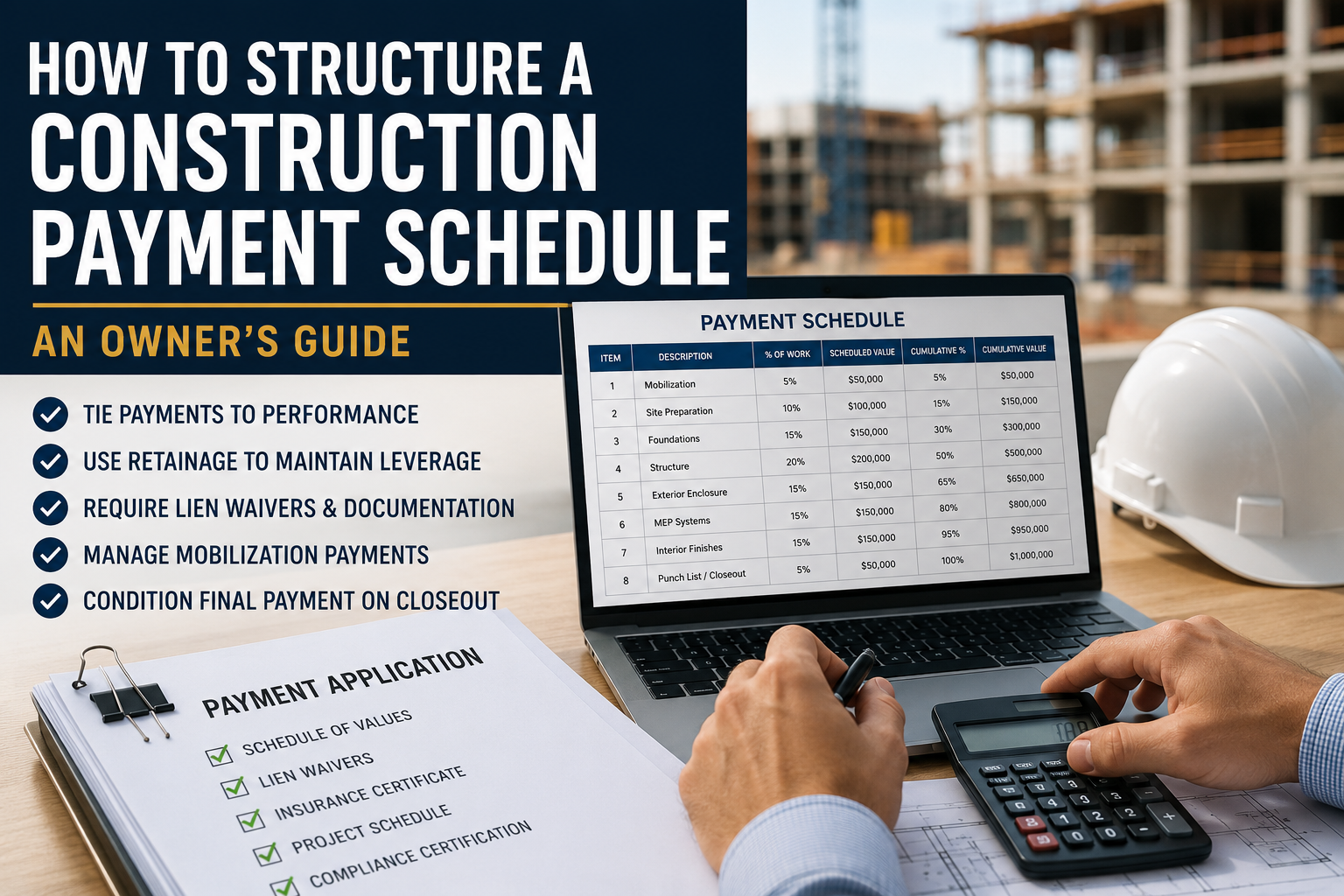
Tie Construction Payments to Performance
The most important principle of an owner-friendly construction payment schedule is that payments should be tied to actual performance.
Progress payments should be based on either:
- Verified completion of specific project milestones; or
- The percentage of work completed in place.
Owners should require that progress be verified by the owner's representative, architect, engineer, or construction manager before payment is approved.
This approach minimizes the risk of paying for work that has not been completed and protects the owner if the contractor abandons the project or defaults under the contract.
Owners should be cautious of payment schedules that front-load compensation. When a contractor receives a disproportionate amount of the contract value early in the project, the contractor's financial incentive to complete the remaining work may be reduced.
Ideally, cumulative payments should closely track cumulative project progress throughout construction.
Use Retainage to Maintain Leverage
Retainage remains one of the most valuable tools available to owners.
Retainage involves withholding a percentage of each progress payment until substantial completion or final completion of the project. Typical retainage amounts range from five percent to ten percent of each payment application.
Retainage serves several important purposes:
- Encourages timely completion of the work.
- Provides leverage for resolving punch list items.
- Creates a reserve for correcting defective work.
- Helps ensure subcontractors and suppliers are paid.
- Protects against unresolved claims at project closeout.
Contractors frequently request that retainage be reduced or released once the project reaches a certain completion percentage. Owners should evaluate these requests carefully.
If retainage is reduced before substantial completion, the owner should require confirmation that:
- The project remains on schedule.
- Work completed to date is free of material defects.
- All subcontractors and suppliers have been paid.
- No outstanding claims exist.
Reducing retainage too early can significantly weaken the owner's leverage during the most critical stages of the project.
Require a Detailed Schedule of Values
Before submitting the first payment application, contractors should provide a detailed Schedule of Values ("SOV").
A Schedule of Values allocates the contract price among identifiable portions of the work and serves as the foundation for evaluating future payment applications.
Owners should carefully review the Schedule of Values to ensure that:
- Values are reasonably allocated among project activities.
- Mobilization costs are not overstated.
- Early-stage activities are not assigned disproportionate value.
- The schedule accurately reflects the anticipated progression of the work.
An improperly structured Schedule of Values can undermine the protections created by a milestone-based payment schedule and result in overpayment during the early phases of construction.
Establish a Clear Payment Application Process
The construction contract should include a detailed procedure for submitting and reviewing payment applications.
Owners should retain the right to:
- Verify completed work before approval.
- Reject unsupported payment requests.
- Adjust quantities or percentages claimed.
- Request additional documentation.
A typical payment process includes:
- Contractor submits a payment application.
- Owner reviews supporting documentation.
- Owner verifies completed work.
- Approved amounts are processed for payment.
The contract should also specify a reasonable review period. Thirty days from receipt of a conforming payment application is common on many projects.
Importantly, the contract should clarify that submission of an incomplete or inaccurate payment application restarts the review period once the deficiencies are corrected.
Include Conditions Precedent to Payment
Owners should require certain conditions to be satisfied before any payment obligation arises.
Common conditions precedent include:
Partial Lien Waivers
Contractors and subcontractors should provide lien waivers covering previous payment periods before receiving additional funds.
Proof of Insurance
The contractor should maintain all required insurance throughout the project and provide updated certificates upon request.
Updated Project Schedule
The owner should receive updated schedules demonstrating that work remains on track.
Compliance Certifications
The contractor should certify compliance with applicable permits, laws, regulations, and contractual requirements.
These requirements provide valuable insight into project health and can identify potential problems before they escalate into major disputes.
Handle Mobilization Payments Carefully
Many contractors request an upfront mobilization payment to cover initial project costs.
While mobilization payments are often justified, owners should carefully limit their use.
Any mobilization payment should:
- Be clearly defined in the contract.
- Reflect actual mobilization costs.
- Be supported by documentation.
- Be secured by a payment bond, letter of credit, or other security.
- Be amortized through future progress payments.
Owners should avoid large upfront payments that are not tied to actual project value.
Protect Against Risks Associated with Stored Materials
Some contracts allow contractors to seek payment for materials stored off-site before installation.
If owners agree to pay for stored materials, they should require:
- Evidence that the materials have been purchased.
- Identification of the materials as owner property.
- Proof of insurance coverage.
- Secure storage at an approved location.
- Appropriate lien waivers.
Without these protections, owners may pay for materials that are later lost, damaged, or never incorporated into the project.
Address Change Orders in Advance
The payment schedule should clearly explain how change order work will be compensated.
Owners should generally require:
- Written approval before changed work begins.
- Agreed pricing before performance.
- Payment through the normal payment application process.
The contract should also state that contractors may not stop work while change order disputes remain unresolved.
Instead, disputes should be addressed through the contract's dispute resolution procedures while construction continues.
This prevents contractors from using payment disagreements as leverage to delay project completion.
Structure Final Payment Carefully
Final payment should be one of the last obligations an owner performs under the construction contract.
Before releasing final payment, owners should require:
- Completion of all punch list items.
- Delivery of as-built drawings.
- Delivery of operation and maintenance manuals.
- Transfer of warranties.
- Required owner training.
- Final lien waivers from all project participants.
- Resolution of all outstanding claims.
Many owners also condition final payment upon expiration of the applicable mechanic's lien filing period.
Where the lien period extends beyond practical project closeout, owners may instead require a bond sufficient to protect against future lien claims.
Common Owner Mistakes with Construction Payment Schedules
Owners frequently create unnecessary risk by:
- Paying contractors ahead of project progress.
- Accepting inflated schedules of values.
- Reducing retainage too early.
- Failing to require lien waivers.
- Paying for stored materials without adequate safeguards.
- Making large mobilization payments without security.
- Releasing final payment before closeout requirements are complete.
Avoiding these mistakes can significantly reduce disputes and improve project outcomes.
Conclusion
A well-structured construction payment schedule protects an owner's investment throughout the life of a project. By tying payments to verified performance, maintaining retainage, requiring lien waivers, carefully managing mobilization payments, and conditioning final payment upon complete project closeout, owners can preserve leverage while encouraging timely and quality performance.
Owners who view the payment schedule as a strategic risk-management tool—not merely an accounting function—are far more likely to complete projects successfully while minimizing disputes, cost overruns, and mechanic's lien exposure.
Get the Free Construction Contract
Red Flags Checklist!