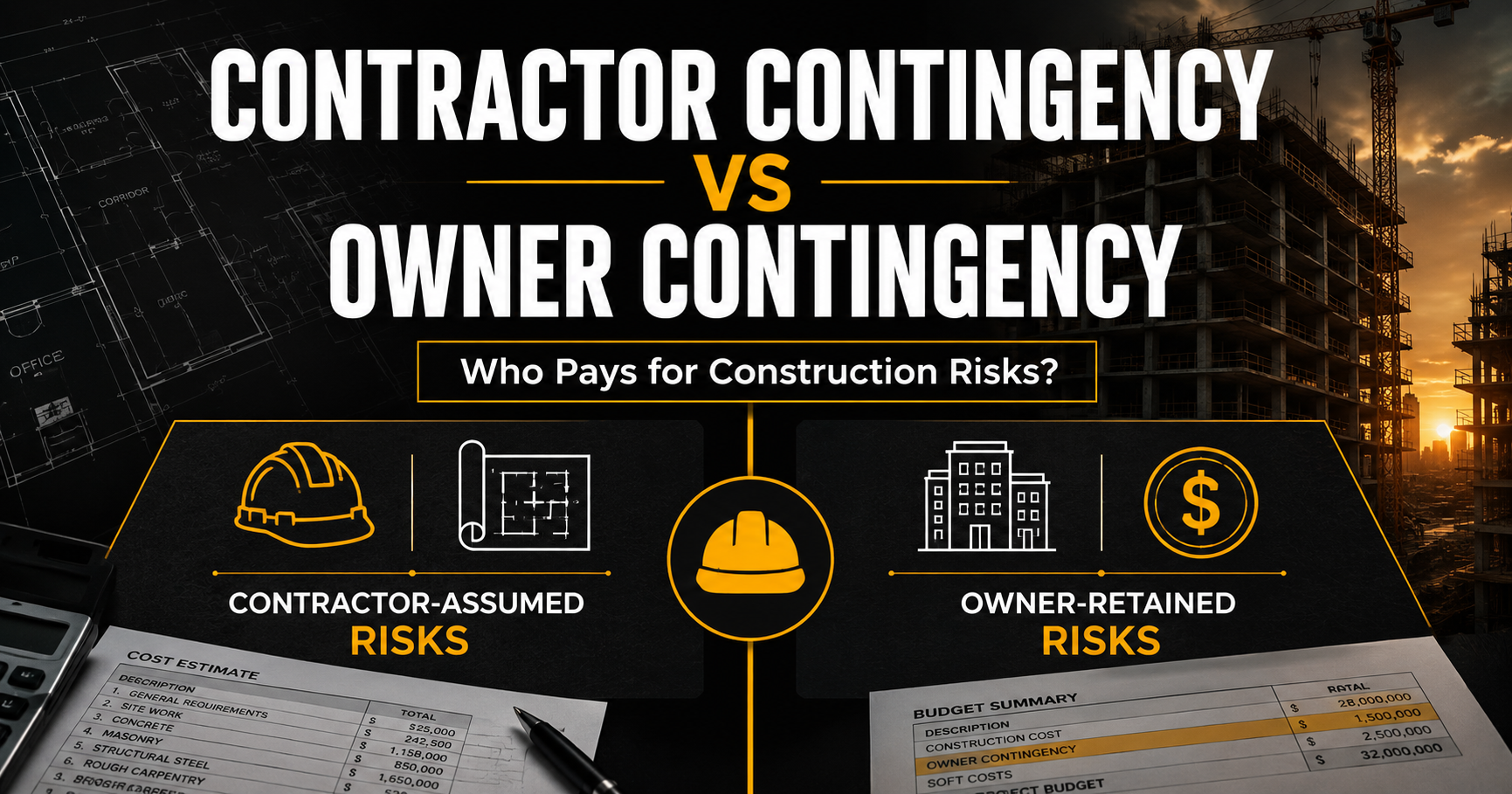
Contractor Contingency vs Owner Contingency: Understanding Construction Project Contingencies
In construction projects, few budgeting concepts are as important—and as frequently misunderstood—as contingency. Whether a project is delivered through a lump sum contract, design-build agreement, or Guaranteed Maximum Price (GMP) arrangement, contingency serves as a financial buffer against uncertainty.
The most common types of contingency are contractor contingency and owner contingency. While both exist to address unexpected costs, they serve very different purposes and are tied directly to the allocation of risk within the construction contract.
Understanding the difference between contractor contingency and owner contingency can help owners, contractors, and construction managers avoid disputes, properly manage budgets, and successfully navigate unforeseen project challenges.
Contractor Contingency vs Owner Contingency: Quick Answer
Contractor contingency and owner contingency are both financial reserves used to address uncertainty during construction projects. The key difference is risk allocation. Contractor contingency covers risks assumed by the contractor, such as estimating variances and design development costs, while owner contingency covers risks retained by the owner, including scope changes, unforeseen site conditions, and design errors. Properly managing both contingencies helps reduce disputes, minimize change orders, and control project costs.
What Is Contractor Contingency?
Definition and Purpose
Contractor contingency is a sum of money included within the contractor's bid or Guaranteed Maximum Price (GMP) to cover costs arising from risks that the contractor has assumed under the construction contract.
These are risks that fall within the contractor's scope of responsibility but cannot be precisely quantified when pricing is established.
Contractor contingency is commonly found in:
- Guaranteed Maximum Price (GMP) contracts
- Construction Manager at Risk (CMAR) projects
- Design-build projects
- Early procurement or phased construction projects
Because these delivery methods often involve pricing work before design completion, contractors include contingency to absorb anticipated costs associated with design development, estimating uncertainty, and construction coordination.
Appropriate Uses of Contractor Contingency
Contractor contingency should be used only for risks allocated to the contractor.
Common examples include:
Design Development Costs
When a GMP is established before construction documents are fully complete, the contractor may need contingency to address costs that arise as the remaining design details are finalized.
Estimating Variances
No estimate is perfect. Material quantities, labor productivity, and subcontractor pricing may differ slightly from assumptions made during the estimating process.
Coordination and Constructability Issues
Field coordination challenges and constructability issues that arise during construction are often appropriate uses of contractor contingency, provided they are not caused by owner-directed changes or design errors.
Contractor Contingency Example
Consider a hospital renovation project delivered under a CMAR contract with a GMP of $42 million established at 75% design completion.
The contractor includes a contingency of $1.2 million.
During construction, the final mechanical design requires additional duct supports and hangers not reflected in the original estimate. The added cost is $68,000.
Because the cost results from normal design completion rather than an owner-directed change, the contractor draws from its contingency rather than issuing a change order.
Similarly, if labor productivity is lower than expected because crews must work in occupied hospital spaces, the contractor may use contingency to absorb those additional labor costs.
The GMP remains unchanged.
What Is Owner Contingency?
Definition and Purpose
Owner contingency is a separate reserve fund maintained by the owner outside of the construction contract amount.
Unlike contractor contingency, owner contingency is not included in the GMP or contract sum. Instead, it remains part of the overall project budget and can only be accessed through approved change orders or contract amendments.
Owner contingency exists because owners also retain risks throughout the construction process.
Appropriate Uses of Owner Contingency
Owner contingency is typically used to address owner-retained risks.
Common examples include:
Owner-Directed Scope Changes
If the owner decides to upgrade finishes, add square footage, modify layouts, or install additional equipment, the resulting costs are generally funded through owner contingency.
Differing Site Conditions
Many contracts allocate unknown subsurface conditions, hazardous materials, and concealed conditions to the owner.
When these issues arise, owner contingency is often used to fund the associated change order.
Design Errors and Omissions
Although the owner may later pursue recovery from the design professional, the immediate cost of corrective work is often funded from owner contingency to avoid project delays.
Regulatory and Code Changes
Changes in applicable codes, regulations, or permitting requirements occurring after contract execution may require additional work that is funded through owner contingency.
Owner Contingency Example
Consider a commercial office project with a construction contract value of $28 million.
The owner establishes a total project budget of $32 million, including a $1.5 million owner contingency.
During excavation, contaminated soil is discovered that was not identified in the geotechnical report.
Under the contract, this is an owner-retained risk.
The contractor submits a $375,000 change order to remediate the contaminated material.
The owner approves the change order and funds it from owner contingency.
Later, the owner upgrades the lobby finishes, adds decorative lighting, and installs a feature wall at a cost of $215,000.
These elective improvements are also funded through owner contingency.
Key Differences Between Contractor Contingency and Owner Contingency
Contractor ContingencyOwner ContingencyIncluded within the contract amount or GMPHeld outside the contract amountCovers contractor-assumed risksCovers owner-retained risksUsed for design development and estimating uncertaintyUsed for scope changes and unforeseen conditionsTypically managed by the contractorManaged solely by the ownerMay require owner reporting or approvalUsed through formal change ordersOften subject to GMP savings-sharing provisionsNot typically subject to savings-sharing provisions
The most important distinction is simple:
Contractor contingency covers risks the contractor accepted. Owner contingency covers risks the owner retained.
Best Practices for Managing Construction Contingency
Clearly Define Risk Allocation
The construction contract should clearly identify which risks belong to the contractor and which remain with the owner.
Disputes frequently arise when contracts fail to clearly define the proper use of contingency funds.
Maintain Transparency
Contractors should provide regular contingency reports showing:
- Original contingency amount
- Approved draws
- Remaining balance
- Forecasted future usage
Owners should similarly track owner contingency expenditures against the overall project budget.
Right-Size the Contingency
Projects with incomplete designs generally require larger contingency reserves.
A GMP established at 50% design completion typically requires more contingency than one established at 90% design completion.
Factors affecting contingency levels include:
- Design completion
- Project complexity
- Site conditions
- Schedule constraints
- Existing building conditions
- Regulatory risks
Avoid Treating Contingency as a Slush Fund
Every contingency draw should be documented and justified.
Contractor contingency should not be used to cover clear estimating mistakes.
Owner contingency should not be depleted on discretionary upgrades to the point that insufficient reserves remain for genuine unforeseen conditions.
Frequently Asked Questions About Construction Contingency
What is contractor contingency?
Contractor contingency is money included within a contractor's bid or Guaranteed Maximum Price (GMP) to cover risks and uncertainties assumed by the contractor under the construction contract.
What is owner contingency?
Owner contingency is a separate reserve fund maintained by the owner outside the construction contract to address owner-retained risks such as scope changes, differing site conditions, and design errors.
Is contractor contingency included in the GMP?
Yes. Contractor contingency is typically included within the GMP and is used to absorb contractor-assumed risks without increasing the contract price.
Can contractor contingency be used for owner changes?
Generally no. Owner-directed scope changes should be funded through change orders and owner contingency rather than contractor contingency.
How much contingency should a construction project have?
The appropriate contingency depends on project complexity, design completion, site conditions, and overall project risk. Projects with incomplete designs generally require higher contingency percentages than projects with nearly complete construction documents.
Conclusion
Contractor contingency and owner contingency are essential tools for managing uncertainty in construction projects, but they serve fundamentally different purposes.
Contractor contingency addresses risks assumed by the contractor, including design development, estimating variances, and coordination challenges. Owner contingency addresses risks retained by the owner, including scope changes, unforeseen site conditions, design errors, and regulatory changes.
When both contingencies are properly sized, clearly defined in the contract, and managed with discipline and transparency, they provide the financial flexibility necessary to deliver successful construction projects while minimizing disputes and budget overruns.
Get the Free Construction Contract
Red Flags Checklist!