How Much Retainage Is Too Much? Construction Retainage Guide
Retainage is one of the most common payment mechanisms in the construction industry. While it serves a legitimate purpose by protecting owners against incomplete or defective work, retainage can also become a significant source of cash-flow problems, payment disputes, and litigation when too much money is withheld for too long.
The question is not whether retainage should exist. The real question is: how much retainage is too much?
What Is Retainage in Construction?
Retainage (sometimes called "retention") is the practice of withholding a percentage of each progress payment owed to a contractor or subcontractor until substantial completion, final completion, or another contractually defined milestone.
The purpose of retainage is simple: it creates a financial incentive for contractors to complete their work, correct deficiencies, and satisfy all contractual obligations.
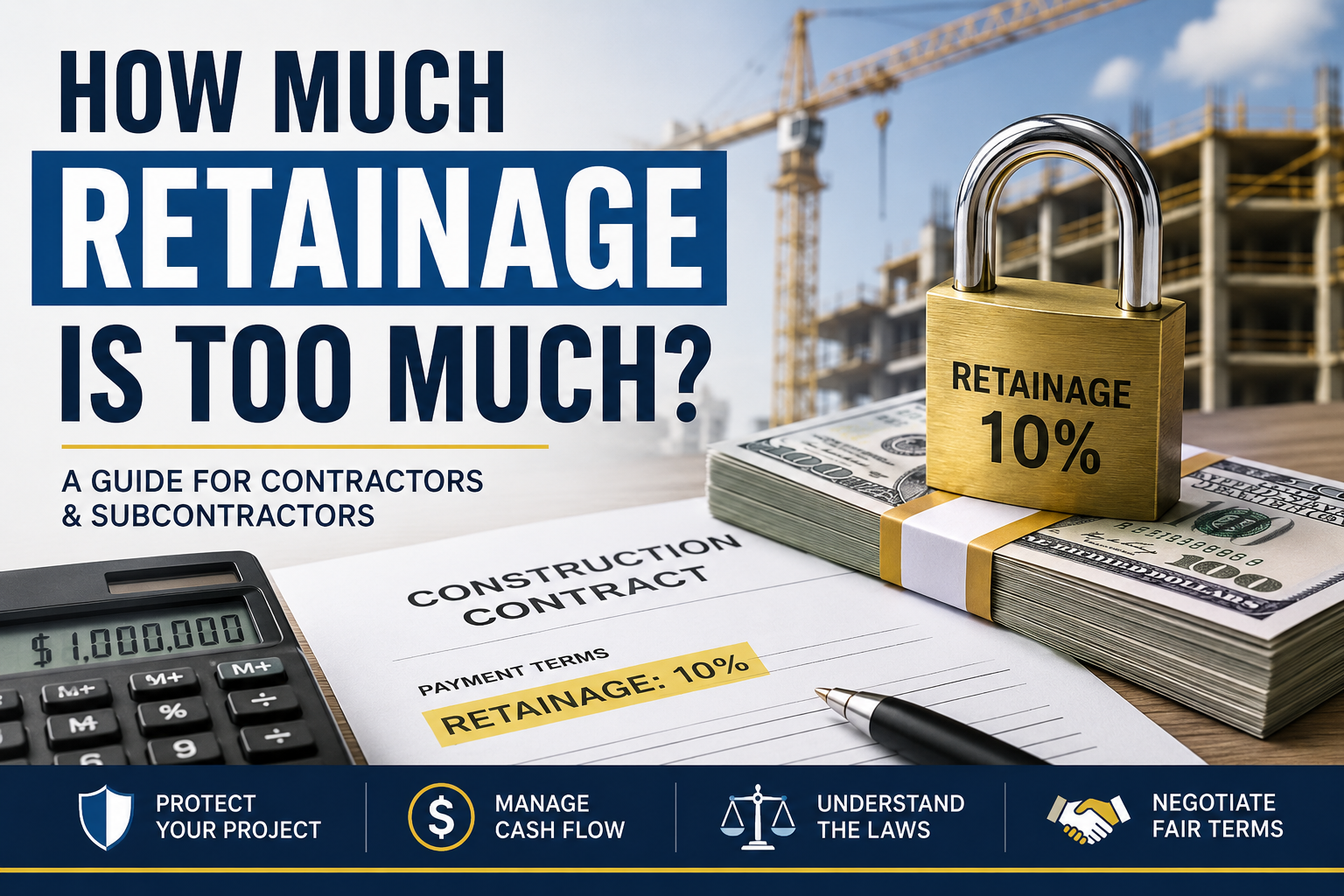
For example, if an owner withholds 10% retainage on a $1,000,000 contract, the contractor receives $900,000 throughout the project and the remaining $100,000 once the retainage release requirements are satisfied.
While this arrangement can protect owners, excessive retainage often shifts a disproportionate financial burden onto contractors and subcontractors who must continue funding labor, materials, equipment, and overhead while waiting for payment.
The Traditional 10% Retainage Standard
For decades, 10% has been the default retainage rate on many construction projects throughout the United States.
Many industry participants treat 10% as a standard rule, but there is nothing inherently magical about that number. The 10% convention developed during a time when construction projects were smaller, bonding requirements were less common, and owners had fewer risk-management tools available.
Today's construction environment is very different. Performance bonds, payment bonds, insurance products, and sophisticated project management systems provide owners with multiple layers of protection beyond retainage.
Consider a simple example.
A general contractor enters into a $10 million contract with a public owner. A 10% retainage provision means the owner will withhold $1 million during the project. If the contractor expects an 8% profit margin, its anticipated profit is only $800,000.
In other words, the retainage amount exceeds the contractor's entire anticipated profit on the project.
The same issue becomes even more pronounced for subcontractors, who often operate on thinner margins and have less access to capital.
When Does Retainage Become Excessive?
There is no universal threshold at which retainage becomes excessive. The answer depends on factors such as project type, risk allocation, contractor financial strength, project duration, and applicable state laws.
However, several situations frequently indicate that retainage has crossed the line from reasonable protection to unreasonable financial burden.
Retainage Rates Above 10%
While 10% is common, some private contracts still require retainage rates of 15% or even 20%.
A 20% retainage provision on a $5 million subcontract results in $1 million being withheld. For many subcontractors, that amount can severely impact payroll, material purchases, and the ability to pursue additional work.
High retainage rates effectively force contractors to finance the project owner's risk management strategy at their own expense.
For this reason, many states have enacted statutory retainage caps, particularly on public construction projects.
Failure to Reduce Retainage at Substantial Completion
Even a 10% retainage rate can become excessive if the party holding the funds refuses to reduce or release retainage when substantial completion is achieved.
Imagine a mechanical subcontractor completes 98% of its work on a hospital project. Only minor punch-list items remain, valued at approximately $5,000.
If the general contractor continues withholding the entire $300,000 retainage balance on a $3 million subcontract, the amount retained bears little relationship to the value of the remaining work.
This type of dispute is one of the most common sources of friction on construction projects.
Retainage Held Long After Project Completion
Time matters.
A 5% retainage provision may be perfectly reasonable if payment is released promptly after completion. However, the same retainage becomes problematic if it is held for months—or even years—after the contractor's work is finished.
For example, a paving subcontractor that completed its work in March should not still be waiting for retainage in December simply because unrelated portions of the project remain unfinished.
At that point, retainage begins to resemble an interest-free loan rather than a legitimate performance incentive.
Retainage Applied to Stored Materials
Another common concern involves retainage on stored materials.
Suppose a steel fabricator delivers $500,000 worth of structural steel to the project site. If the owner withholds 10% retainage, the fabricator loses immediate access to $50,000 despite already purchasing and delivering the materials.
Many modern construction contracts now exclude stored materials from retainage calculations because the materials have already been acquired and delivered, reducing much of the owner's associated risk.
State Laws Limiting Retainage
Recognizing the potential for abuse, many state legislatures have enacted laws regulating retainage practices, particularly on public projects.
Public Project Retainage Caps
Several states limit retainage to 5% on public construction projects.
These statutes reflect a growing recognition that higher retainage percentages often impose significant financial burdens without providing proportional benefits to project owners.
Early Release Requirements
Some states require retainage to be reduced or eliminated after a project reaches a certain percentage of completion, often 50%.
The reasoning is straightforward: a contractor who has successfully completed half of a project has demonstrated reliability and reduced the owner's risk exposure.
Prompt Payment Statutes
Many states also require retainage to be released within a specified period after the conditions for payment have been satisfied.
Failure to release retainage within the statutory deadline may expose the withholding party to:
- Interest penalties
- Attorney's fees
- Breach of contract claims
- Prompt payment violations
Federal Construction Projects
Federal projects generally permit retainage but increasingly encourage alternative forms of performance security.
The overall trend at the federal level has been toward lower retainage rates and earlier release of retained funds.
How Excessive Retainage Hurts Contractors and Subcontractors
Excessive retainage impacts more than just the contractor whose money is being withheld.
Increased Project Costs
When contractors anticipate substantial retainage, they often increase bid prices to account for financing costs.
The result is simple: excessive retainage frequently increases project costs for owners.
Reduced Competition
Qualified contractors may decline to pursue projects with unreasonable retainage provisions.
As competition decreases, owners often receive fewer bids and potentially pay higher prices.
Damaged Business Relationships
Retainage disputes frequently strain relationships between owners, general contractors, and subcontractors.
Contractors known for delaying retainage payments often struggle to attract high-quality subcontractors in future projects.
In an industry built on repeat relationships, a reputation for slow payment can be costly.
Best Practices for Fair Retainage Clauses
The most effective retainage provisions balance owner protection with contractor cash-flow realities.
Use Retainage Proportionate to Risk
Retainage should reflect the actual risk of non-performance.
On bonded projects involving financially strong contractors, retainage rates of 5% or less are often sufficient.
Reduce Retainage as the Project Progresses
Risk decreases as work is completed.
Contracts that reduce retainage after 50% completion are generally more balanced than those maintaining the same percentage throughout the entire project.
Release Retainage Promptly
Retainage should be released as soon as contractual release requirements are satisfied.
Tying release to unrelated portions of a project often creates unnecessary disputes.
Consider Alternatives to Retainage
Owners may achieve similar protection through:
- Retainage bonds
- Letters of credit
- Escrow arrangements
- Performance bonds
These alternatives can provide security while allowing contractors to maintain healthier cash flow.
Frequently Asked Questions About Retainage
Can retainage exceed 10%?
Yes. Private contracts sometimes require retainage above 10%, although many states impose statutory limits on public projects.
When should retainage be released?
The answer depends on the contract and applicable law. In many cases, retainage is released upon substantial completion, final completion, or satisfaction of specific closeout requirements.
Is retainage required by law?
Generally no. Retainage is typically a contractual risk-allocation mechanism, although many states regulate its use.
Can subcontractors recover improperly withheld retainage?
Often yes. Contract claims, prompt payment statutes, and mechanic's lien rights may provide remedies when retainage is wrongfully withheld.
Conclusion
Retainage serves an important purpose in construction projects, but it should not become a tool for shifting excessive financial risk onto contractors and subcontractors.
A retainage provision becomes problematic when the amount withheld bears little relationship to the remaining work, when funds are held long after completion, or when contractors are forced to finance project risks that could be addressed through less burdensome alternatives.
The construction industry continues moving toward lower retainage percentages, earlier release of retained funds, and alternative security mechanisms. That trend reflects a growing recognition that excessive retainage harms not only contractors and subcontractors, but also project owners and the industry as a whole.
Protect Your Cash Flow Before You Sign
Before signing your next construction contract, review retainage percentages, release provisions, prompt payment requirements, and substantial completion language carefully.
A retainage clause that appears harmless at contract execution can significantly impact profitability by the time the project is complete.

Get the Free Construction Contract
Red Flags Checklist!