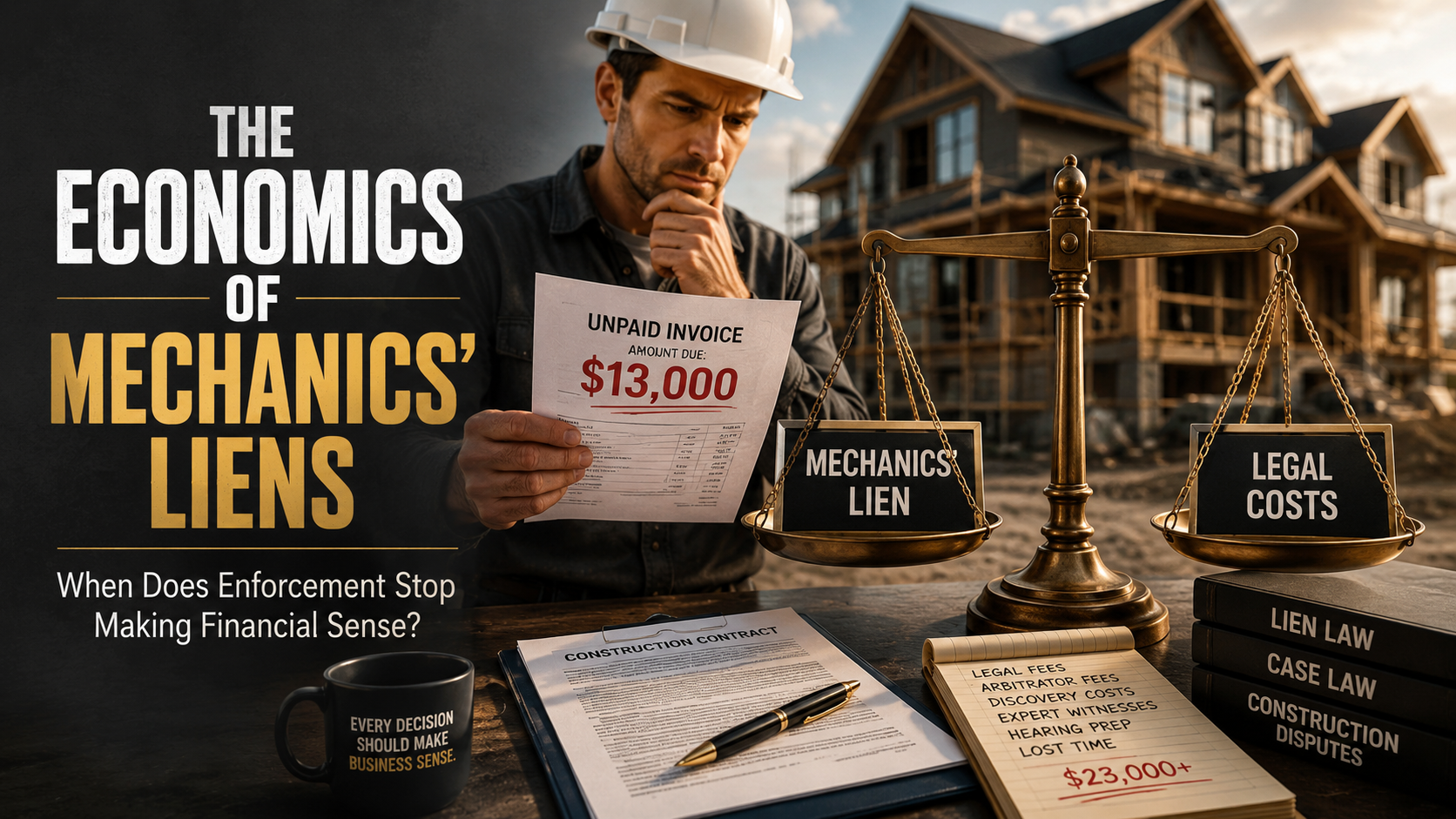
The Economics of Mechanics' Liens: When Is It Worth Enforcing a Construction Lien?
The Economics of Mechanics' Liens: When Is Enforcement Worth the Cost?
Mechanics' liens are among the most powerful payment recovery tools available to contractors, subcontractors, suppliers, and design professionals. A properly filed mechanics' lien can cloud title, interfere with refinancing or sale of a property, and create substantial pressure on an owner to resolve an unpaid construction invoice.
Because of this leverage, many construction professionals assume that filing a mechanics' lien automatically leads to payment. Unfortunately, that assumption often overlooks a critical reality: filing a lien and enforcing a lien are two very different things.
While filing a mechanics' lien is often inexpensive and highly effective, enforcing that lien through litigation or arbitration can become extraordinarily costly. In some cases, the legal fees required to pursue recovery exceed the value of the underlying claim.
Before initiating a lien foreclosure action, contractors should ask a simple business question:
Does pursuing this claim make economic sense?
The answer is not always yes.
Why Mechanics' Liens Are Powerful Collection Tools
A mechanics' lien is unique because it attaches to the property itself rather than simply creating a contractual claim against the party that failed to pay.
For property owners, a lien can create significant complications:
- Delays in property sales
- Difficulties obtaining financing
- Additional title requirements
- Concerns from lenders and investors
- Potential foreclosure proceedings
Because of these consequences, many payment disputes are resolved shortly after a lien is filed.
In fact, the lien filing itself is often the most cost-effective step in the collection process. The filing creates leverage while requiring relatively little financial investment from the claimant.
The challenge arises when the lien alone does not produce payment.
At that point, the claimant must decide whether pursuing formal enforcement is economically justified.
The Hidden Cost of Enforcing a Mechanics' Lien
Many contractors underestimate the cost of construction litigation and arbitration.
Regardless of whether a claim is worth $13,000 or $130,000, the legal process often involves many of the same procedural steps:
- Drafting pleadings
- Responding to defenses and counterclaims
- Written discovery
- Document production
- Depositions
- Motion practice
- Expert review
- Hearing preparation
- Trial or arbitration
These expenses accumulate quickly.
Unlike construction projects, legal costs do not scale proportionally with claim size. A dispute involving a relatively small invoice may require nearly the same effort as a substantially larger claim.
As a result, smaller mechanics' lien claims frequently encounter what can be described as a break-even problem.
A $13,000 Mechanics' Lien Example
Consider a contractor who completes work on a residential project and is owed $13,000. The contractor properly preserves lien rights and records a mechanics' lien against the property. The owner refuses payment. The contractor then hires counsel and begins enforcement proceedings.
Amount Owed
Original unpaid balance: $13,000
Legal Fees Incurred
By the time the matter progresses through initial pleadings, discovery, and hearing preparation, the contractor has incurred approximately: $13,000 in attorney fees At this point, the contractor is effectively down: $26,000.
This includes:
- $13,000 unpaid contract balance
- $13,000 spent pursuing collection
Arbitration and Hearing Costs
Assume the dispute proceeds to a streamlined arbitration hearing. Additional expenses may include:
- Arbitrator fees
- Hearing costs
- Additional attorney preparation
- Witness preparation
- Attendance at hearing
These expenses can easily add another: $10,000
Best-Case Outcome
Assume the contractor wins completely. Further assume the tribunal awards:
- Full lien amount
- Attorney fees equal to the lien value
Total recovery: $26,000
Less additional hearing costs:
($10,000)
Net result:
Approximately $3,000 in actual economic benefit
After months or even years of litigation risk, the contractor's practical gain may be surprisingly modest.
Worst-Case Outcome
If the contractor loses, the situation becomes significantly worse.
Potential consequences include:
- No recovery of the lien amount
- Responsibility for the contractor's own legal fees
- Potential exposure to the opposing party's attorney fees
- Additional arbitration or court costs
A relatively small payment dispute can quickly become a substantial financial loss.
The Break-Even Point for Mechanics' Lien Claims
The example above illustrates a common issue in construction disputes. At some point, the cost of enforcement approaches the value of the claim itself. When that occurs, the claimant may be spending a dollar to recover a dollar. From a business perspective, that is rarely a desirable outcome. Every contractor should identify an economic threshold at which pursuing full lien enforcement becomes financially reasonable. The exact number will vary depending on:
- Jurisdiction
- Attorney rates
- Complexity of the dispute
- Court procedures
- Arbitration requirements
- Availability of attorney fee recovery
Nevertheless, many contractors find that claims below approximately $25,000 deserve careful scrutiny before initiating full-scale enforcement proceedings.
When Does It Make Sense to Foreclose a Mechanics' Lien?
Claims Under $10,000
Generally, these claims present the most difficult economics. The cost of litigation often approaches or exceeds the value of the claim. In many situations, filing the lien and pursuing aggressive settlement efforts may be the most rational approach.
Claims Between $10,000 and $25,000
These cases require careful evaluation. Contractors should assess:
- Strength of the claim
- Available documentation
- Contract terms
- Likelihood of fee recovery
- Opposing party's financial condition
Some claims in this range justify enforcement. Others do not.
Claims Above $25,000
At higher claim values, the economics typically become more favorable. The available recovery creates greater room to absorb legal expenses while still producing a meaningful net return. This does not eliminate risk, but it often improves the cost-benefit analysis significantly.
Filing a Lien Versus Enforcing a Lien
One of the most important distinctions contractors should understand is the difference between filing and enforcing. Many contractors achieve successful payment recovery without ever reaching the enforcement stage. The lien itself often creates sufficient pressure to bring parties to the negotiating table.
Attorney Fee Clauses Can Change the Economics
Many construction contracts and state statutes include prevailing party attorney fee provisions. These provisions can significantly improve the economics of pursuing a mechanics' lien claim. However, contractors should not assume attorney fees will automatically be recovered.
Several risks remain:
- Courts may reduce requested fees
- Arbitrators may award only partial fees
- Prevailing party status may be disputed
- Counterclaims can complicate recovery
Most importantly, fee-shifting provisions operate in both directions. If the contractor loses, the contractor may become responsible for the opposing party's attorney fees. That possibility should always be included in any cost-benefit analysis.
A Practical Strategy for Contractors
Rather than viewing lien enforcement as an all-or-nothing decision, contractors should adopt a tiered strategy.
Step 1: Preserve Your Rights
Maintain compliance with all notice and filing requirements. Missed deadlines can eliminate leverage entirely.
Step 2: File the Lien Promptly
The lien itself often produces results. Many owners become substantially more motivated to resolve payment disputes after title is affected.
Step 3: Evaluate Settlement Opportunities
Before initiating expensive litigation, objectively assess potential settlement outcomes. A discounted settlement today may be worth more than a full recovery years later.
Step 4: Analyze the Economics
Estimate:
- Attorney fees
- Arbitration costs
- Expert costs
- Collection risks
- Probability of success
Treat the decision as an investment analysis rather than an emotional response.
Step 5: Proceed Only When the Numbers Work
Principle is understandable. Anger is understandable. But neither changes the economics. The most successful contractors approach payment disputes as business decisions, not personal battles.
Conclusion
Mechanics' liens remain one of the most effective payment recovery tools available in the construction industry. Filing a lien is often inexpensive, strategic, and highly effective.
Enforcing a lien, however, is a different matter entirely.
The decision to pursue foreclosure or arbitration should be based on a realistic assessment of costs, risks, and potential recovery. Contractors who establish clear economic thresholds, evaluate attorney fee exposure, and make decisions grounded in business judgment are more likely to achieve favorable outcomes.
In construction disputes, winning the case is important. Making money on the case is even more important.
Protect Yourself Before Payment Problems Begin
Most collection disputes start long before the lien is filed. They begin with poorly drafted contracts, unfavorable payment provisions, unclear notice requirements, and risk-shifting language that contractors overlook during negotiations.
The Subcontract Risk Toolkit helps contractors identify dangerous contract provisions before signing and provides practical guidance for preserving payment rights when disputes arise.
The best mechanics' lien strategy is preventing the payment dispute that makes the lien necessary in the first place.
Get the Free Construction Contract
Red Flags Checklist!