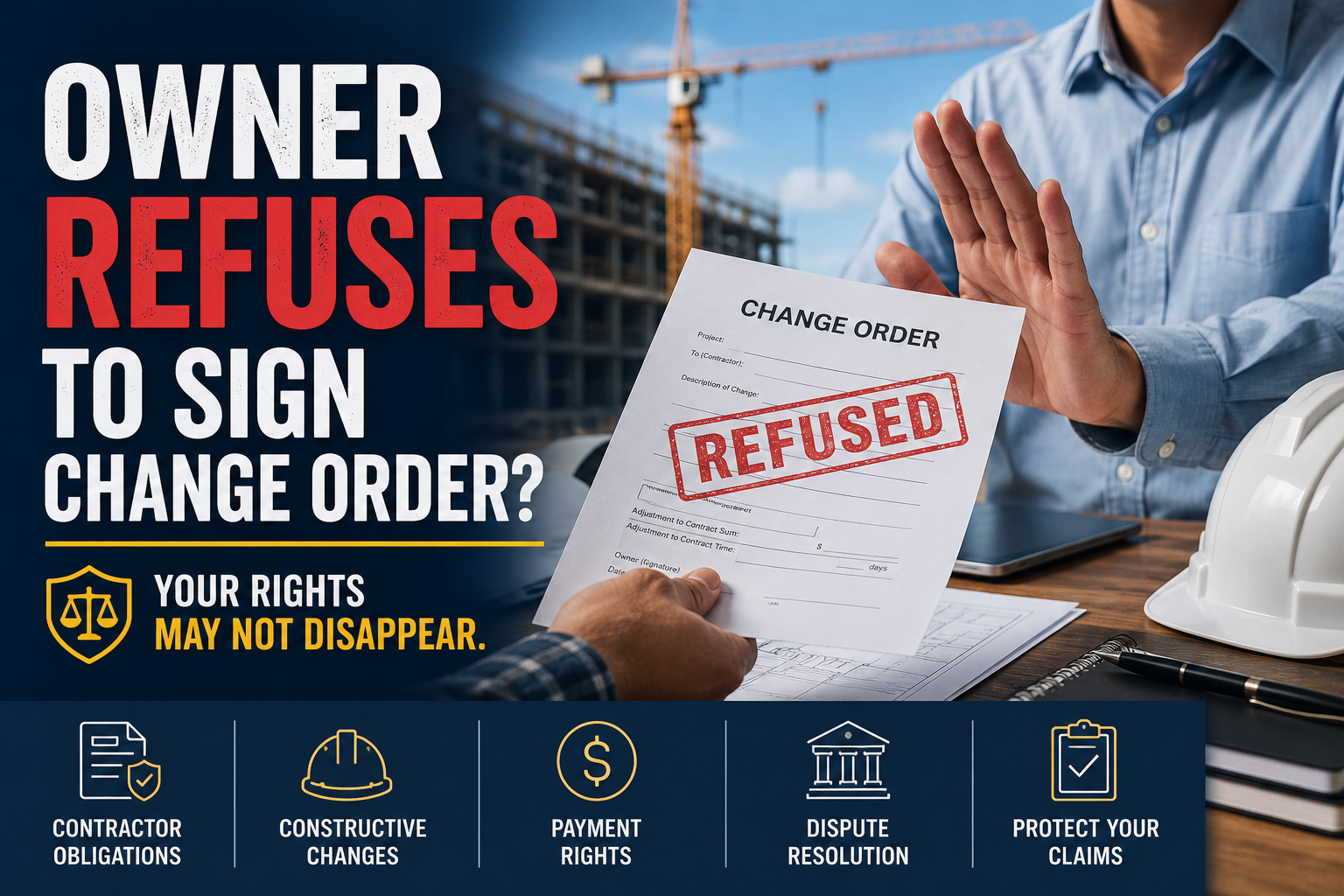
What Happens If an Owner Refuses to Sign a Change Order? | Contractor Guide
Construction projects rarely proceed exactly as planned. Unforeseen site conditions, design revisions, owner requests, and regulatory requirements often require changes to the original scope of work. These changes are typically documented through a change order.
But what happens when an owner refuses to sign a change order?
Many contractors assume that an unsigned change order means the work should stop. In reality, most construction contracts impose continuing obligations on the contractor while preserving certain rights to seek compensation later.
Understanding how construction change order disputes work can help contractors avoid costly mistakes and protect their ability to recover payment.
Why Change Orders Matter
A change order is a written amendment to the construction contract that modifies:
- Scope of work
- Contract price
- Project schedule
- Contract terms
Standard contracts such as AIA, ConsensusDocs, and EJCDC forms typically require mutual agreement before a change order becomes binding.
Once signed, the change order becomes part of the contract and eliminates uncertainty regarding payment and scheduling impacts.
Why Owners Refuse to Sign Change Orders
Owners commonly reject or delay change orders for several reasons.
Scope Disputes
The owner may believe the work was already included in the original contract.
Pricing Concerns
The owner may agree that extra work is necessary but disagree with the contractor's pricing.
Budget Constraints
Additional costs may exceed project budgets or lender approvals.
Negotiation Tactics
Some owners intentionally delay signing to pressure contractors into performing extra work without additional compensation.
Regardless of the reason, refusing to sign a change order does not necessarily eliminate the contractor's right to payment.
Can a Contractor Stop Work If the Change Order Is Not Signed?
Usually not.
Most construction contracts contain a duty-to-proceed clause requiring the contractor to continue performing work while disputes are resolved.
For example, under AIA A201, contractors are generally required to continue work even when a change order claim remains unresolved.
Stopping work without contractual authorization may expose the contractor to:
- Breach of contract claims
- Liquidated damages
- Back charges
- Termination for default
This creates a difficult situation because contractors may be required to perform disputed work before receiving payment approval.
Construction Change Directives: When Work Must Continue
Many contracts contain provisions allowing owners to direct work before a final change order is signed.
Under AIA contracts, this tool is called a Construction Change Directive (CCD).
A CCD allows:
- Work to proceed immediately
- Price disputes to be resolved later
- Schedule impacts to be addressed after performance
The purpose is to prevent project delays while preserving each party's rights.
What Is a Constructive Change?
Even without a signed change order, a contractor may still have a valid claim.
A constructive change occurs when the owner's actions effectively require work outside the original contract scope.
Common examples include:
Verbal Instructions
An owner directs additional work during a project meeting.
Revised Plans
The architect issues updated drawings that expand the scope.
Increased Inspection Requirements
Additional testing or quality-control requirements are imposed after contract execution.
Owner Interference
Owner actions increase labor or material costs beyond what the contract contemplated.
Courts and arbitrators frequently recognize constructive change claims when the contractor can prove the work exceeded the original scope.
How Contractors Protect Their Right to Payment
If an owner refuses to sign a change order, documentation becomes critical.
1. Follow Notice Requirements
Most contracts require written notice of claims.
Deadlines are often:
- 7 days
- 14 days
- 21 days
Missing a notice deadline can completely eliminate an otherwise valid claim.
2. Document Everything
Maintain:
- Daily reports
- Photographs
- Labor records
- Equipment logs
- Material invoices
Good documentation often determines the outcome of a construction change order dispute.
3. Reserve Rights in Writing
Email correspondence should clearly state:
- Why the work is outside the original scope
- That additional compensation is expected
- That the contractor reserves all contractual rights
4. Segregate Costs
Track extra work separately from base contract work.
This creates a clear damages record if litigation or arbitration becomes necessary.
Options When a Change Order Dispute Cannot Be Resolved
Contract Claims Process
Most construction contracts establish a formal claims procedure that must be followed before litigation.
Mediation
Mediation allows a neutral third party to help the parties negotiate a settlement.
Benefits include:
- Lower cost
- Faster resolution
- Preservation of business relationships
Arbitration
Many construction contracts require arbitration.
Advantages include:
- Privacy
- Faster resolution
- Industry-experienced decision makers
Litigation
Court proceedings may be appropriate when arbitration is not required.
Litigation offers:
- Discovery rights
- Motion practice
- Appeal rights
However, it is often the most expensive option.
Can a Contractor File a Mechanic's Lien for Change Order Work?
In many states, yes.
A contractor who performs unpaid change order work may have mechanic's lien rights.
Lien laws vary significantly by state and require strict compliance with:
- Notice requirements
- Filing deadlines
- Enforcement procedures
A properly filed lien can provide significant leverage in resolving payment disputes.
Risks for Owners Who Refuse Legitimate Change Orders
Owners also face significant risks when refusing to approve valid change orders.
Potential consequences include:
- Delay claims
- Interest charges
- Attorney's fees
- Mechanic's liens
- Breach of contract claims
An unreasonable refusal can ultimately cost substantially more than addressing the issue promptly.
Contractor Checklist: Owner Refuses to Sign a Change Order
Before proceeding, ask yourself:
✓ Have I provided written notice?
✓ Does the contract require me to continue working?
✓ Have I documented all additional work?
✓ Am I tracking extra costs separately?
✓ Has the owner issued verbal or written directives?
✓ Are mechanic's lien deadlines approaching?
✓ Have I reserved my rights in writing?
Taking these steps can significantly improve the likelihood of recovering compensation.
Real-World Example
Assume a contractor is hired to construct a commercial office building. During excavation, the contractor encounters unsuitable soils that were not disclosed in the geotechnical report. The contractor submits a change order seeking additional compensation and a schedule extension.
The owner refuses to sign, claiming the issue falls within the contractor's scope.
Despite the dispute, the contractor continues work, provides timely written notice, documents all additional labor and equipment costs, and tracks those costs separately. Months later, through mediation and arbitration, the contractor successfully recovers the additional costs because the work constituted a constructive change beyond the original contract scope.
This example illustrates why documentation and compliance with notice requirements are often more important than obtaining an immediate signature.
Conclusion
An owner's refusal to sign a change order does not automatically eliminate a contractor's right to payment. Contractors may still have valid claims through constructive change theories, contractual claims procedures, mechanic's lien rights, or other legal remedies.
The key is documentation, compliance with notice requirements, and understanding the dispute resolution process established by the contract. Contractors who properly preserve their rights place themselves in the strongest position to recover compensation for extra work, even when a signed change order never materializes.
Free Construction Contract Red Flags Checklist
Many payment disputes begin long before the first change order is submitted.
Download the Free Construction Contract Red Flags Checklist to identify risky contract provisions before you sign and reduce the likelihood of costly disputes over change orders, payment, delays, and claims.
Get the Free Construction Contract
Red Flags Checklist!