Pay-If-Paid vs. Pay-When-Paid Clauses: Why Every Contractor and Subcontractor Must Know the Difference
One of the most important provisions in any construction subcontract is the payment clause. Yet many contractors and subcontractors overlook the distinction between two commonly used provisions: pay-if-paid clauses and pay-when-paid clauses.
Although the names sound similar, these clauses allocate payment risk in dramatically different ways. A subcontractor working under a pay-when-paid provision may simply experience a delay in payment. A subcontractor working under a pay-if-paid provision could perform the work perfectly and still never get paid.
Understanding the difference is critical before signing any construction contract.
What Is a Pay-When-Paid Clause?
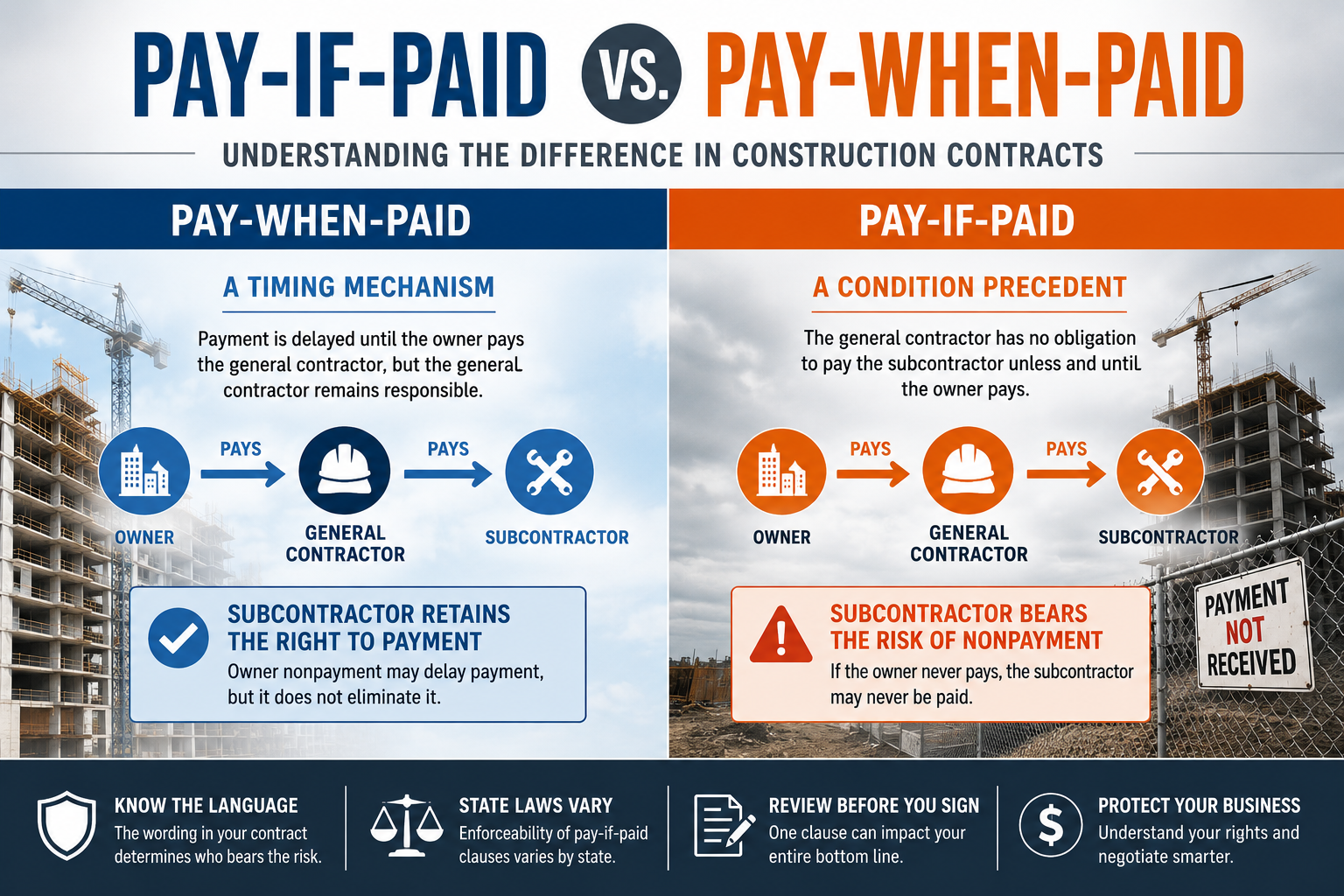
A pay-when-paid clause is generally considered a timing mechanism.
Under a pay-when-paid provision, the general contractor agrees to pay the subcontractor after receiving payment from the owner. However, the general contractor's obligation to pay is not eliminated if the owner never pays.
In most jurisdictions, courts interpret pay-when-paid clauses as requiring payment within a reasonable period of time, even if the owner defaults.
Example of a Pay-When-Paid Clause
Assume:
- General Contractor: Alpha Construction
- Subcontractor: Beta Electrical
- Subcontract Amount: $500,000
The subcontract states:
"Contractor shall pay Subcontractor within fourteen (14) days after Contractor receives payment from the Owner."
Beta Electrical completes its work and submits an invoice.
Scenario 1: Owner Pays
The owner pays Alpha Construction 30 days later.
Alpha Construction must pay Beta Electrical within the agreed 14-day period.
Scenario 2: Owner Never Pays
The owner becomes insolvent and never pays Alpha Construction.
In most states, Beta Electrical can still recover payment after a reasonable amount of time has passed because the clause only affects timing—not ultimate responsibility.
Key Takeaway
Under a pay-when-paid clause:
- Payment may be delayed
- General contractor remains responsible
- Subcontractor retains the right to payment
- Owner nonpayment does not permanently eliminate payment rights
What Is a Pay-If-Paid Clause?
A pay-if-paid clause operates very differently.
Rather than controlling timing, a pay-if-paid clause creates a condition precedent to payment.
This means the subcontractor is only entitled to payment if the owner first pays the general contractor.
If the owner never pays, the general contractor may have no obligation to pay the subcontractor at all.
Example of a Pay-If-Paid Clause
Assume:
- General Contractor: Gamma Builders
- Subcontractor: Delta Plumbing
- Contract Amount: $750,000
The subcontract states:
"Receipt of payment from the Owner shall be a condition precedent to Contractor's obligation to pay Subcontractor."
Delta Plumbing completes its work.
The owner later files bankruptcy and never pays Gamma Builders.
If the pay-if-paid clause is enforceable, Delta Plumbing may recover nothing despite fully performing its scope of work.
Key Takeaway
Under a pay-if-paid clause:
- General contractor shifts risk
- Owner payment is a condition precedent
- Subcontractor may never be paid
- Owner insolvency risk transfers to subcontractor
Are Pay-If-Paid Clauses Enforceable?
The answer depends on state law.
Many jurisdictions limit or prohibit pay-if-paid clauses because courts view them as unfair risk-shifting provisions.
Other states allow enforcement but require very clear language.
States That Often Restrict Pay-If-Paid Clauses
Some states have statutes or case law limiting enforcement, including:
- California
- New York
- North Carolina (in many circumstances)
- South Carolina
- Other states with prompt payment protections
States That Frequently Enforce Pay-If-Paid Clauses
Many states will enforce them if the contract clearly establishes a condition precedent, including:
- Florida
- Georgia
- Texas (subject to statutory requirements)
Because state law varies significantly, parties should consult local law before relying on any payment provision.
Why Pay-If-Paid Clauses Are Dangerous for Subcontractors
Many subcontractors focus on scope, schedule, and price when reviewing contracts.
The payment clause often receives far less attention.
That can be a costly mistake.
Consider a roofing subcontractor performing $300,000 of work under a pay-if-paid clause.
The roofing work is completed perfectly.
Later, the owner withholds payment because of a dispute involving an unrelated trade contractor.
If the clause is enforceable, the roofing subcontractor could lose its entire contract balance despite having done nothing wrong.
This is why pay-if-paid provisions are often considered one of the most significant risk-shifting clauses in construction contracts.
How to Identify a Pay-If-Paid Clause
Subcontractors should watch for language such as:
- "Condition precedent"
- "Owner payment is a condition precedent to payment"
- "Subcontractor assumes the risk of owner nonpayment"
- "Contractor shall have no obligation to pay unless and until payment is received from Owner"
These phrases often indicate a true pay-if-paid clause.
How to Negotiate a Better Payment Provision
Before signing a subcontract, consider the following:
Requesting Pay-When-Paid Language
A pay-when-paid clause still allows reasonable payment timing flexibility while preserving payment rights.
Reviewing the Owner's Financial Strength
If a pay-if-paid provision remains, understanding the owner's financial condition becomes more important.
Preserving Mechanic's Lien Rights
Mechanic's lien rights may provide an alternative path to recovery when payment disputes arise.
Confirming Payment Bond Coverage
On bonded projects, payment bond claims can provide another source of protection.
Final Thoughts
The difference between a pay-if-paid clause and a pay-when-paid clause can determine who bears the risk when a project owner fails to pay.
A pay-when-paid clause generally delays payment.
A pay-if-paid clause can eliminate payment entirely.
For contractors and subcontractors alike, understanding these provisions before signing a subcontract is essential. One sentence buried deep within a construction contract can determine whether a company gets paid for months of work—or not at all.
Free Construction Contract Review Checklist
Before signing your next subcontract, make sure you identify payment clauses, indemnity provisions, notice requirements, change order restrictions, and other common contract traps.
Download the Free Construction Contract Red Flags Checklist and learn how to spot high-risk provisions before they become expensive problems.
Get the Free Construction Contract
Red Flags Checklist!