Retainage in Construction: What Contractors Need to Know Before Signing a Contract
Most contractors focus on the contract price when bidding a project. Unfortunately, many overlook one contract provision that can significantly impact cash flow: retainage.
Retainage is one of the most common payment provisions in construction contracts, yet it remains one of the least understood. Whether you are a homeowner building an addition, a small business owner renovating a commercial space, or a contractor performing construction work, retainage can have a meaningful impact on your finances.
Understanding how retainage works before signing a contract can help contractors protect their cash flow, avoid payment disputes, and negotiate more favorable contract terms.
What Is Retainage in Construction?
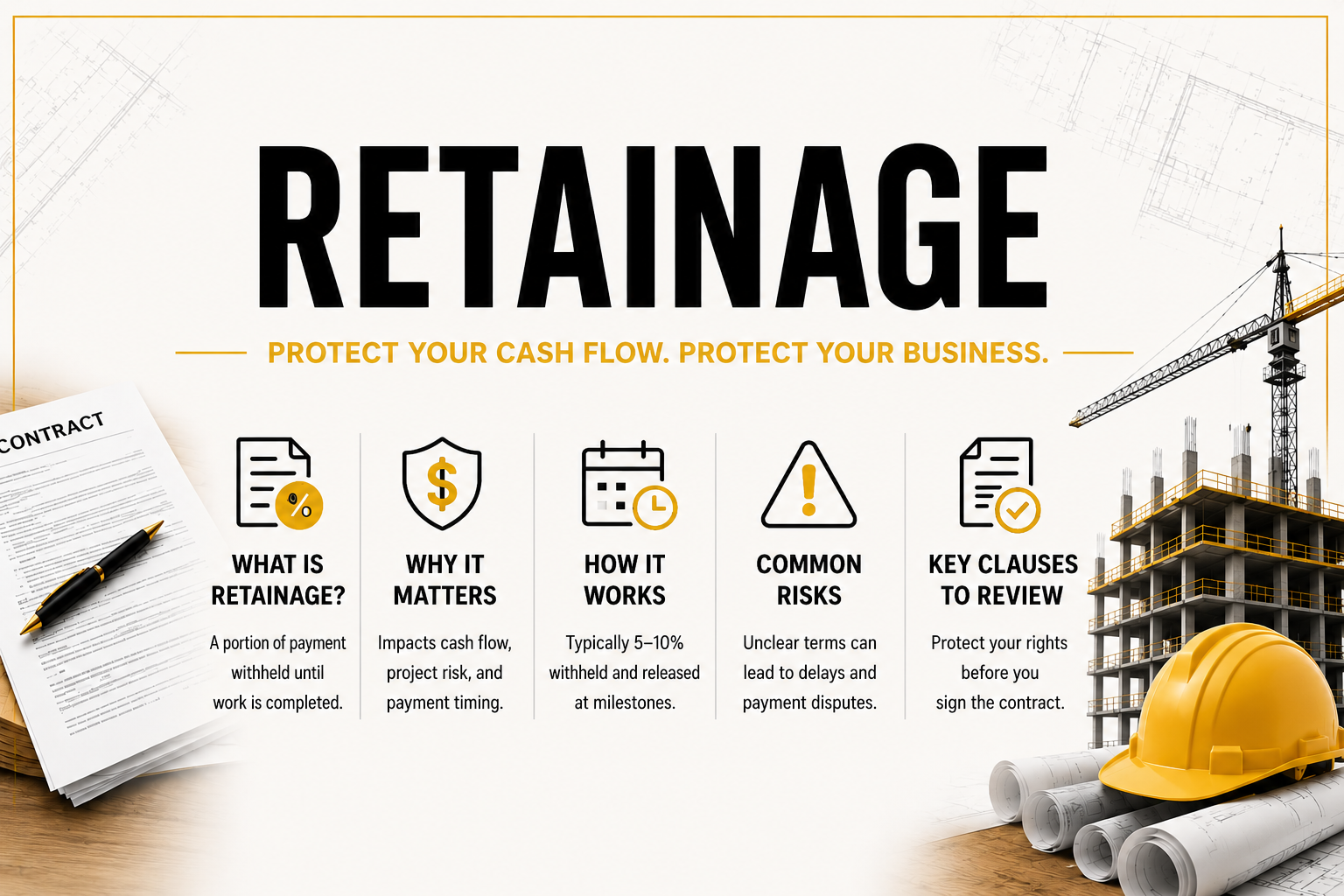
Retainage, sometimes called retention, is the practice of withholding a percentage of each payment otherwise due to a contractor or subcontractor until certain project milestones have been achieved.
The purpose of retainage is to provide security for the project owner and create a financial incentive for the contractor to complete the work and correct any deficiencies.
In most construction contracts, retainage is set at a fixed percentage of each progress payment, typically between five percent and ten percent. The withheld funds accumulate throughout the project and are released when the contractor satisfies the contractual requirements for final payment.
For owners, retainage provides leverage to ensure the project is completed properly. For contractors, however, retainage can create significant cash flow challenges if not carefully managed.
How Retainage Works: A Simple Example
Consider a small commercial renovation project with a contract value of $200,000.
The contract requires ten percent retainage to be withheld from each progress payment.
By the end of the project, the owner has withheld $20,000 in retainage.
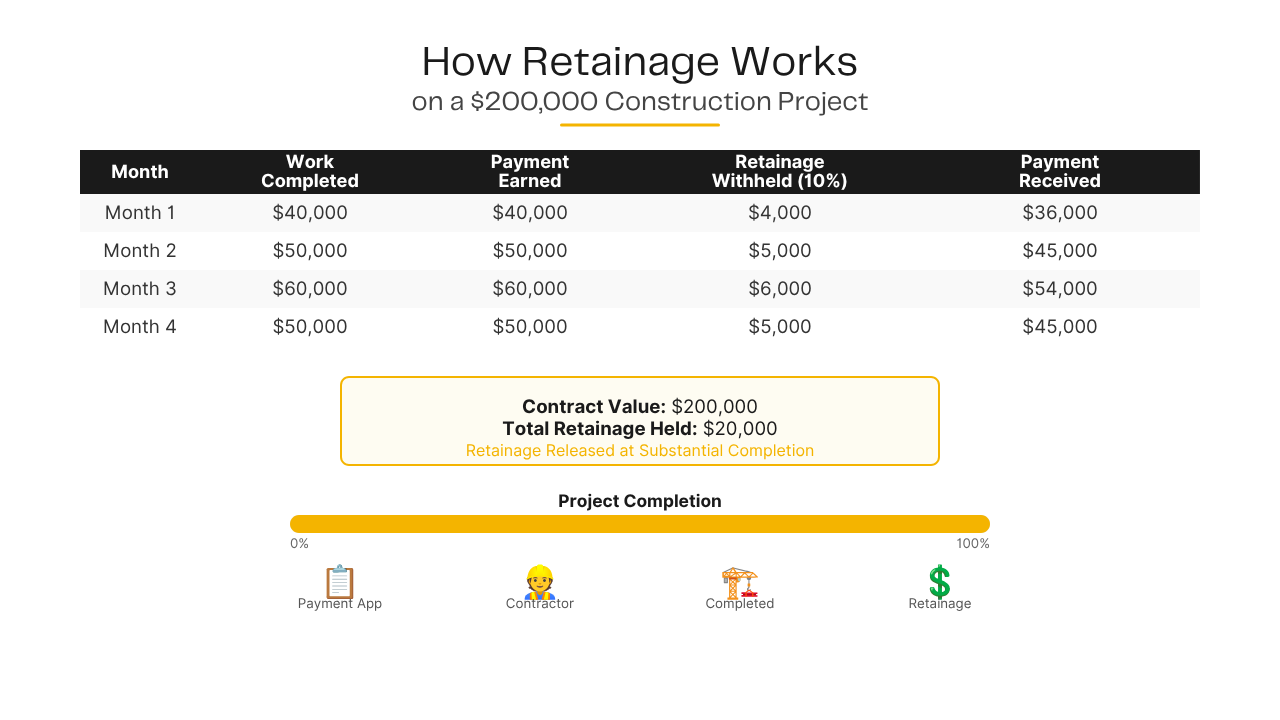
The contractor may not receive that final $20,000 until the project reaches substantial completion, punch list items are completed, lien waivers are submitted, warranties are provided, and other contractual closeout requirements are satisfied.
Why Owners Use Retainage
From an owner's perspective, retainage serves several important purposes:
- Encourages contractors to complete the project.
- Creates leverage to ensure punch list items are addressed.
- Provides security against defective work.
- Helps protect the owner if the contractor defaults.
- Creates a financial reserve that can be used to complete unfinished work if necessary.
Construction projects involve risk, and retainage is one of the primary tools owners use to manage that risk.
Why Contractors Dislike Retainage
While retainage benefits owners, contractors often view it differently.
Cash Flow Challenges
Construction is a cash-intensive business. Contractors must pay employees, suppliers, equipment costs, insurance premiums, and overhead long before retainage is released.
When ten percent of every payment is withheld, contractors effectively finance part of the project using their own money.
Delayed Profit Recovery
For many contractors, retainage represents a significant portion of their expected profit on a project.
Waiting months to receive retainage can substantially impact profitability and working capital.
Increased Financial Risk
Retainage can become particularly problematic when payment is delayed for reasons unrelated to the contractor's work.
For example, a contractor may have completed its scope perfectly but still be forced to wait for retainage because another trade has not completed its work or because the owner has delayed project closeout.
Retainage and Subcontractors
Retainage becomes even more challenging for subcontractors.
In most projects, the owner withholds retainage from the general contractor, and the general contractor withholds retainage from subcontractors.
This creates a cascading payment structure.
Imagine a small electrical subcontractor performing $30,000 worth of work on a residential addition project.
If the general contractor withholds ten percent retainage, the subcontractor receives only $27,000 during construction while $3,000 remains outstanding.
For a small trade contractor, that $3,000 may represent a substantial portion of the project's profit.
Even worse, the subcontractor may complete its work months before the overall project is finished. Despite completing its obligations, it may still be required to wait until final project completion before receiving retainage.
Many subcontractors effectively finance construction projects while waiting for retainage to be released.
Can Retainage Be Negotiated?
Many contractors assume retainage terms are non-negotiable. In reality, retainage provisions are often negotiable, particularly on smaller private projects.
Consider discussing the following options during contract negotiations:
Reduce the Retainage Percentage
A reduction from ten percent to five percent can dramatically improve cash flow throughout the project.
Step-Down Retainage
Some contracts allow retainage to decrease after the project reaches a certain completion milestone, such as fifty percent completion.
Early Release for Completed Trades
Subcontractors should seek language allowing retainage to be released once their scope of work is complete and accepted.
A plumbing subcontractor who finishes work during month three of a twelve-month project should not necessarily have to wait nine additional months for payment.
Escrow or Trust Account Requirements
In some jurisdictions, retainage may be required to be held in a separate account. Contractors should understand whether those protections apply.
State Retainage Laws Matter
Retainage laws vary significantly from state to state.
Some states limit retainage to five percent. Others impose deadlines for releasing retainage after substantial completion. Certain jurisdictions require owners to pay interest on improperly withheld retainage.
Because retainage requirements differ substantially across the country, contractors should familiarize themselves with applicable state laws before signing a construction contract.
Understanding local retainage laws can provide valuable leverage during negotiations and help prevent unlawful payment practices.
Five Retainage Red Flags Contractors Should Watch For
Before signing a construction contract, contractors should carefully review retainage provisions for the following warning signs:
1. No Deadline for Release
The contract should clearly state when retainage will be released.
2. Excessive Retainage Percentages
Retainage exceeding ten percent should receive careful scrutiny.
3. Owner Has Sole Discretion
Avoid language allowing an owner to determine retainage release entirely at its own discretion.
4. Unclear Closeout Requirements
Retainage release conditions should be objective and clearly defined.
5. Pay-If-Paid Retainage Clauses
Subcontractors should be particularly cautious when retainage release depends upon the general contractor first receiving payment from the owner.
Practical Tips for Small Contractors
To better manage retainage, contractors should:
- Negotiate lower retainage percentages whenever possible.
- Request step-down retainage provisions.
- Understand all conditions required for release.
- Submit closeout documentation promptly.
- Track retainage balances throughout the project.
- Review applicable state retainage laws before signing the contract.
- Address retainage issues during contract negotiations rather than after disputes arise.
Practical Tips for Project Owners
Owners should also approach retainage thoughtfully.
Best practices include:
- Using retainage as a reasonable security mechanism rather than a punishment.
- Considering five percent retainage on smaller projects.
- Clearly defining release conditions in the contract.
- Promptly releasing retainage once conditions are satisfied.
- Maintaining open communication with contractors throughout project closeout.
Fair retainage practices often lead to better project relationships and smoother project completion.
Final Thoughts
Retainage is a standard feature of construction contracts, but it can significantly impact project cash flow and profitability.
For contractors and subcontractors, understanding retainage provisions before signing a contract is critical. A seemingly minor change to a retainage clause can make a substantial difference in when payment is received and how much financial risk is carried throughout the project.
For owners, retainage remains a valuable project management tool when used fairly and consistently.
The most successful construction projects are often those where both parties understand the purpose of retainage, negotiate reasonable terms, and comply with their contractual obligations throughout the life of the project.
Protect Yourself Before You Sign
Many payment disputes begin long before payment is withheld—they begin when the contract is signed.
If you are a subcontractor reviewing a proposed contract, make sure you understand retainage provisions, pay-if-paid clauses, notice requirements, change order procedures, and other terms that may impact your right to payment.

Get the Free Construction Contract
Red Flags Checklist!