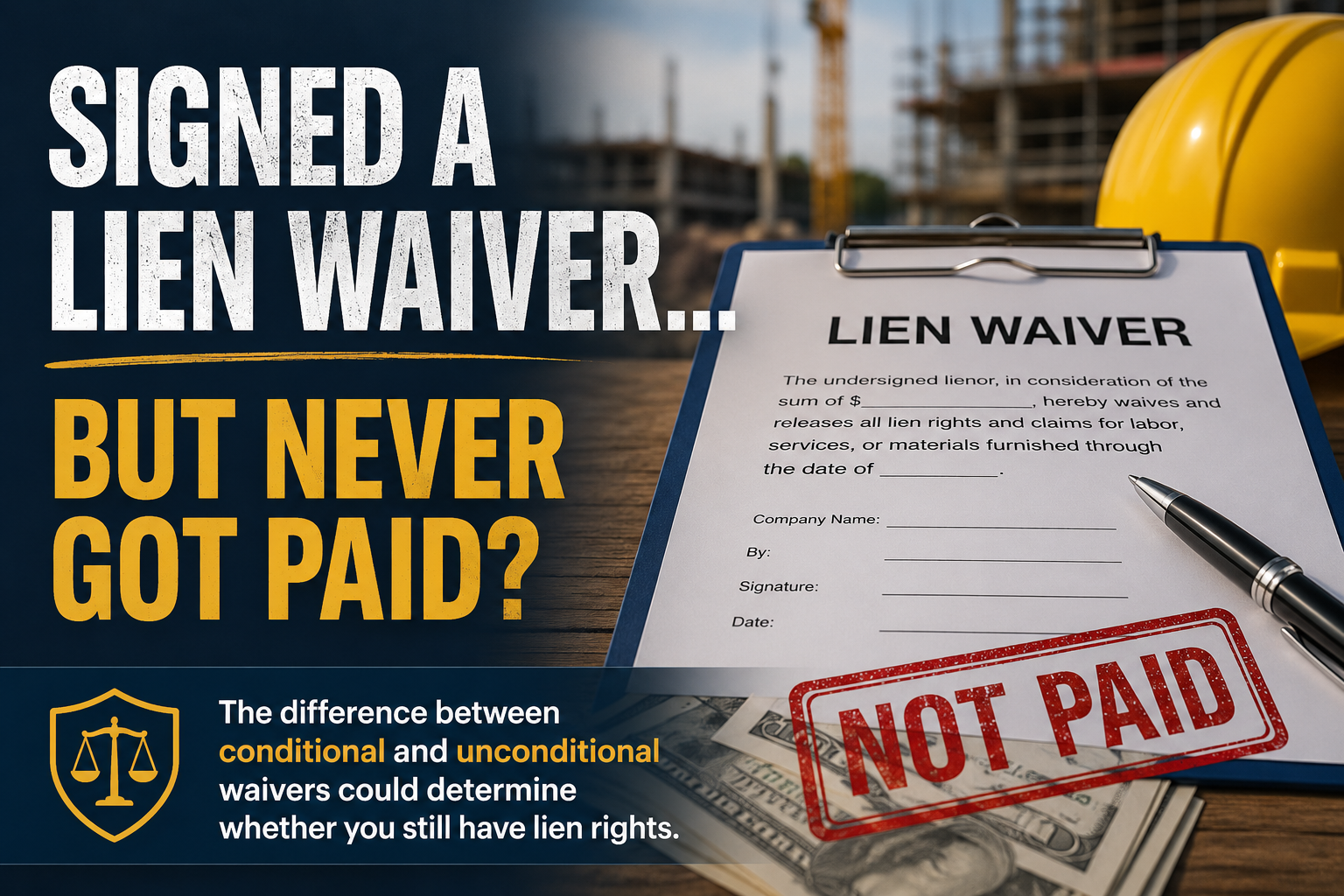
What Happens If You Sign a Lien Waiver but Never Get Paid? Conditional vs. Unconditional Waivers Explained
In the construction industry, few documents create more payment disputes than lien waivers. Contractors, subcontractors, and suppliers are often asked to sign lien waivers as part of the payment process. In most cases, the exchange is straightforward: a payment is issued and a lien waiver is signed. Problems arise when the waiver is signed but the payment never arrives.
So what happens if you sign a lien waiver and don't get paid?
The answer depends almost entirely on whether you signed a conditional lien waiver or an unconditional lien waiver. Understanding the difference can determine whether you still have the right to file a mechanic's lien or whether you have unintentionally waived one of the most powerful collection tools available in the construction industry.
What Is a Lien Waiver?
A lien waiver is a document in which a contractor, subcontractor, or material supplier agrees to waive certain mechanic's lien rights in exchange for payment.
Mechanic's liens provide construction professionals with significant leverage when payment disputes arise. A properly filed lien can encumber the property itself, making it difficult for the owner to sell, refinance, or transfer title until the dispute is resolved.
Because mechanic's liens are such powerful collection tools, property owners, lenders, and general contractors frequently require lien waivers before releasing payment.
The purpose is simple: the paying party wants assurance that the recipient will not later file a lien for work that has already been paid.
While that sounds reasonable, the timing and wording of the waiver can dramatically impact your legal rights.
Why Lien Waivers Matter on Construction Projects
On most construction projects, lien waivers are exchanged throughout the payment cycle.
Owners want protection against future liens.
General contractors want proof that lower-tier subcontractors are being paid.
Lenders want confidence that their collateral is free from potential encumbrances.
As a result, lien waivers become routine paperwork. Unfortunately, many contractors sign them without fully understanding whether they are conditional or unconditional.
That mistake can become extremely expensive when payment problems arise.
Conditional Lien Waivers: Protection Until Payment Is Received
A conditional lien waiver becomes effective only when a specific condition occurs.
In almost every case, the condition is actual receipt of payment.
In practical terms, a conditional waiver states:
"I waive my lien rights only if and when I receive the payment identified in this waiver."
Until payment is actually received, the waiver has no legal effect.
This makes conditional waivers the safer option for contractors, subcontractors, and suppliers because they align the surrender of lien rights with actual compensation.
Example
Martinez Plumbing completes rough-in work on a commercial project and submits a pay application for $85,000.
The general contractor requests a lien waiver before releasing payment.
Martinez Plumbing signs a conditional lien waiver stating that lien rights are waived only upon receipt of the $85,000 payment.
A week later, the general contractor experiences cash-flow problems and never issues the check.
Because the waiver was conditional, Martinez Plumbing's lien rights remain intact. The company may still file a mechanic's lien, pursue a bond claim if available, or pursue other collection remedies.
The waiver never became effective because the condition—payment—never occurred.
Unconditional Lien Waivers: Why They Are Risky
An unconditional lien waiver operates very differently.
Unlike a conditional waiver, an unconditional waiver becomes effective immediately upon signing, regardless of whether payment has actually been received.
By signing an unconditional waiver, you are effectively stating:
"I have received payment and I waive my lien rights."
There is no condition.
There is no contingency.
There is no automatic protection if payment never arrives.
For that reason, unconditional waivers should generally be used only after payment has been received and verified.
Example
Using the same scenario, Martinez Plumbing signs an unconditional lien waiver for $85,000 because the general contractor promises that payment is "on the way."
The check never arrives.
Martinez Plumbing now faces a significant problem. It has signed a document stating that it has waived its lien rights for that amount.
In many states, the company may no longer be able to file a mechanic's lien for the unpaid work.
Instead, its options may be limited to filing a breach of contract lawsuit, pursuing an unjust enrichment claim, or participating in a bankruptcy proceeding if the contractor becomes insolvent.
Those remedies are often slower, more expensive, and less effective than a mechanic's lien.
Can You File a Mechanics Lien After Signing a Lien Waiver?
The answer depends on the type of waiver you signed.
If You Signed a Conditional Lien Waiver
Generally, yes.
If payment was never received, the waiver never became effective.
You may still have the right to file a mechanic's lien, provided that you comply with all applicable notice and filing deadlines.
If You Signed an Unconditional Lien Waiver
Possibly not.
In many jurisdictions, unconditional lien waivers are enforceable according to their terms.
Courts often treat the signed document as proof that payment has been received, regardless of what actually happened afterward.
Some states provide statutory protections, but many do not.
As a result, signing an unconditional waiver before receiving payment can permanently jeopardize your lien rights.
State Laws Can Change the Outcome
Lien waiver laws vary significantly from state to state.
Some states prescribe mandatory lien waiver forms and impose limitations on how waivers may be used.
For example, California provides statutory protections that may prevent enforcement of certain unconditional waivers when payment was never actually received.
Other states provide little or no protection.
Because mechanic's lien laws differ dramatically across jurisdictions, contractors should always review their state's lien statutes before relying on a particular waiver form.
What Happens If the Check Never Arrives?
The consequences can vary dramatically.
If you signed a conditional waiver, your lien rights generally remain available because payment never occurred.
If you signed an unconditional waiver, recovering payment becomes significantly more difficult.
You may be forced to:
- File a breach of contract lawsuit
- Pursue an unjust enrichment claim
- Assert fraud or misrepresentation claims
- Participate in a bankruptcy proceeding
- Negotiate a settlement without lien leverage
Even if legal arguments exist to challenge the waiver, litigation can be expensive and uncertain.
The best strategy is avoiding the problem altogether.
5 Best Practices Before Signing Any Lien Waiver
1. Never Sign an Unconditional Waiver Before Payment Clears
A promise to pay is not payment.
Wait until checks clear or wire transfers are confirmed before signing any unconditional waiver.
2. Read Every Waiver Carefully
Do not assume all lien waivers are the same.
Review whether the waiver is conditional or unconditional and confirm exactly what rights are being released.
3. Use Statutory Forms Whenever Possible
Many states provide approved lien waiver forms.
Using the statutory form can reduce uncertainty and improve enforceability.
4. Maintain Detailed Records
Keep copies of:
- Signed waivers
- Payment applications
- Checks
- Wire confirmations
- Correspondence regarding payment
Good documentation can become critical if a dispute arises.
5. Establish Clear Payment Procedures in Your Contract
The subcontract or supply agreement should clearly define:
- When waivers are required
- What forms will be used
- When payments are due
- The sequence of payment and waiver exchanges
Clear contract language can prevent many disputes before they occur.
Frequently Asked Questions About Lien Waivers
Can I file a mechanic's lien after signing a lien waiver?
It depends on the type of waiver. Conditional waivers generally preserve lien rights until payment is received. Unconditional waivers may immediately eliminate lien rights.
Is a lien waiver valid if the check bounces?
In many states, a conditional waiver does not become effective if payment fails. State law may also provide protections in certain situations involving unconditional waivers.
Should I sign an unconditional lien waiver before receiving payment?
Generally, no. Contractors should wait until funds have been received and verified before signing an unconditional waiver.
What is the safest type of lien waiver?
A conditional lien waiver is generally safer because it ties the waiver of rights to actual receipt of payment.
Can a lien waiver release more than lien rights?
Yes. Some forms contain broad release language that may waive change order claims, delay claims, retainage claims, and other contract rights. Always review the document carefully.
Final Thoughts
The difference between a conditional lien waiver and an unconditional lien waiver can determine whether you get paid or lose one of your most valuable legal remedies.
A conditional waiver protects your rights until payment is actually received.
An unconditional waiver may eliminate those rights the moment you sign.
Before signing any lien waiver, carefully review the document, verify the payment status, and understand exactly what rights you are releasing.
For contractors, subcontractors, and suppliers, a few extra minutes reviewing a lien waiver can prevent months—or years—of costly payment disputes.
Need to know your lien deadlines? Use our free Mechanics Lien Deadline Lookup Tool to determine notice requirements, filing deadlines, and enforcement deadlines before your rights expire.

Get the Free Construction Contract
Red Flags Checklist!