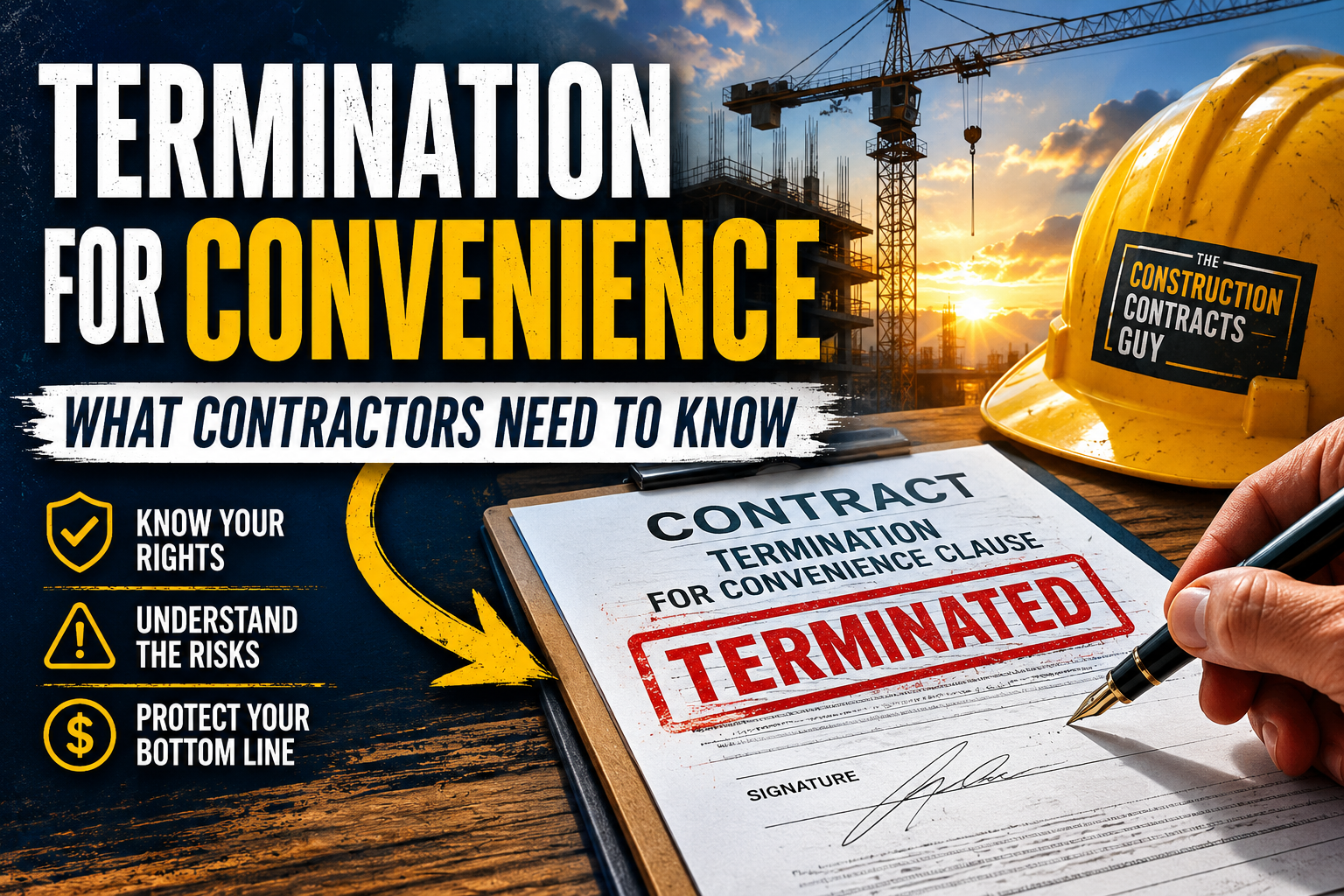
Termination for Convenience Clauses: What Contractors Need to Know Before Signing
Most contractors focus on payment terms, change orders, and indemnity provisions when reviewing a contract. However, one of the most dangerous clauses may be hiding in plain sight: the termination for convenience clause.
A termination for convenience clause allows an owner, developer, government agency, or customer to end a contract without proving the contractor did anything wrong. In many cases, the contractor is paid only for work completed through the termination date and receives nothing for anticipated profits on the remaining work.
Before signing any construction contract, subcontract, service agreement, or consulting agreement, contractors should understand how termination for convenience clauses work and how to negotiate protections that reduce financial risk.
What Is a Termination for Convenience Clause?
A termination for convenience clause gives one party—typically the owner, client, or government agency—the right to terminate a contract at any time, for any reason, or for no reason at all, without proving that the contractor breached the agreement.
The concept originated in federal government contracting, where agencies needed flexibility to respond to changing budgets, shifting priorities, or canceled projects. Today, termination for convenience provisions appear regularly in construction contracts, subcontracts, service agreements, software development contracts, and supply agreements.
While owners value flexibility, contractors face significant risk. A contractor may invest substantial resources in mobilization, staffing, procurement, and project planning only to have the contract terminated before realizing the anticipated return on that investment.
Why Owners Like Termination for Convenience Clauses
Owners and project sponsors often view termination for convenience provisions as a valuable risk management tool.
Common reasons owners exercise these clauses include:
- Project cancellation
- Budget reductions
- Financing issues
- Business restructuring
- Changes in project scope
- Strategic shifts in company priorities
- Vendor consolidation
- Economic uncertainty
Unlike a termination for default, the owner does not need to establish contractor fault before exercising the termination right.
How Termination for Convenience Clauses Work
A typical termination for convenience clause contains several key components:
Who Has the Right to Terminate?
Most clauses grant the right exclusively to the owner, client, or purchaser.
Notice Requirements
The clause generally specifies how much advance written notice must be provided before termination becomes effective.
Compensation Upon Termination
The most important provision for contractors addresses what compensation is available after termination.
For example:
The Owner may, at any time and for any reason, terminate the Contractor's services and work at the Owner's convenience. Upon such termination, the Contractor shall be entitled to payment for all work properly performed through the date of termination, plus reasonable demobilization costs, but shall not be entitled to anticipated profits on unperformed work.
Under this language, the contractor is compensated for completed work but loses any profit it expected to earn on the remainder of the project.
A more contractor-friendly provision may allow recovery of work performed, costs incurred in anticipation of completion, demobilization costs, and profit on completed work.
What Compensation Can Contractors Recover?
When reviewing a termination for convenience clause, contractors should carefully evaluate what costs remain recoverable.
Work Performed
The contractor should receive payment for all work properly completed through the effective termination date.
Materials Purchased
Materials ordered, fabricated, delivered, or specially manufactured for the project should generally be recoverable.
Demobilization Costs
The contractor should recover the cost of removing personnel, equipment, temporary facilities, and project infrastructure.
Subcontractor Termination Costs
Prime contractors often remain liable to subcontractors for cancellation costs and should ensure those expenses are recoverable.
Overhead Costs
Certain project-specific overhead expenses may continue even after termination and should be included in any settlement.
Profit on Completed Work
Contractors should seek language allowing recovery of reasonable profit on work performed rather than reimbursement of direct costs only.
The Biggest Risks for Contractors
Termination for convenience clauses can create significant financial exposure.
Common risks include:
- Loss of anticipated profits
- Unrecoverable startup costs
- Short termination notice periods
- Workforce disruptions
- Equipment commitments
- Material purchase obligations
- Financing costs
- Idle labor expenses
- Subcontractor claims
The earlier a project is terminated, the more severe these impacts can become.
Example: Construction Project Terminated Midway Through Performance
Consider a contractor performing work under a $2,000,000 construction contract with an anticipated profit of $200,000.
After completing 40 percent of the work, the owner exercises its termination for convenience right.
Depending on the contract language, the contractor may recover:
- Payment for completed work
- Stored materials
- Demobilization costs
- Certain subcontractor termination expenses
However, unless the contract provides otherwise, the contractor may lose the remaining $120,000 in anticipated profit associated with the unfinished portion of the project.
This is why negotiating favorable termination language before signing the contract is so important.
How Contractors Should Negotiate Termination for Convenience Clauses
Contractors should not assume termination provisions are non-negotiable. Several strategies can significantly improve protection.
1. Negotiate a Termination Fee
A termination fee can help compensate for startup costs, mobilization expenses, and lost business opportunities.
2. Require Adequate Notice
Notice periods should reflect the complexity of the project. Large construction projects may require 30 days or more to wind down operations properly.
3. Expand Recoverable Costs
The contract should clearly define all recoverable costs, including materials, labor, subcontractor expenses, overhead, and demobilization costs.
4. Protect Profit on Performed Work
Contractors should seek language allowing recovery of reasonable profit on work completed before termination.
5. Consider Mutual Termination Rights
Where appropriate, contractors may negotiate reciprocal termination rights to provide greater flexibility.
6. Review Related Contract Clauses
Termination provisions should be evaluated alongside:
- Indemnity clauses
- Limitation of liability provisions
- Notice requirements
- Payment provisions
- Intellectual property assignments
- Survival clauses
A termination for convenience does not automatically eliminate all contractual obligations.
Frequently Asked Questions
Can an owner terminate a construction contract for convenience?
Yes. If the contract contains a termination for convenience clause, the owner may generally terminate the agreement without proving contractor default.
Can a contractor recover lost profits after termination for convenience?
Usually not. Most termination for convenience clauses exclude recovery of anticipated profits on unperformed work unless specifically negotiated otherwise.
What costs should contractors recover after termination?
Contractors should seek recovery of work performed, materials purchased, subcontractor costs, demobilization expenses, overhead, and profit on completed work.
Are termination for convenience clauses enforceable?
In most jurisdictions, courts generally enforce properly drafted termination for convenience provisions.
Final Thoughts
Termination for convenience clauses are a fact of life in modern construction contracting. While owners value the flexibility these provisions provide, contractors must understand the financial exposure they create.
Before signing any contract, carefully review termination rights, notice requirements, and recoverable cost provisions. A few revisions during contract negotiations can mean the difference between a manageable business setback and a significant financial loss if a project is terminated unexpectedly.
The best time to negotiate a termination for convenience clause is before the contract is signed—not after the termination notice arrives.
Protect Yourself Before You Sign
Most construction disputes begin long before a claim is filed—they begin when a contractor signs a contract without fully understanding the risk allocation provisions.
Download The Construction Contracts Guy's Contract Review Toolkit to identify termination clauses, notice requirements, indemnity provisions, payment traps, and other hidden risks before you sign.
Get the Free Construction Contract
Red Flags Checklist!