No-Damages-for-Delay Clauses in Construction Contracts: What Contractors Need to Know
Construction delays are one of the most common sources of disputes on construction projects. Whether caused by permitting issues, design revisions, owner-directed changes, labor shortages, or poor project coordination, delays often increase a contractor's costs significantly.
Unfortunately, many construction contracts contain provisions that attempt to eliminate a contractor's ability to recover those additional costs. These provisions are commonly known as no-damages-for-delay clauses. Similar risk-allocation provisions appear in Pay If Paid clauses, retainage provisions, and construction indemnity clauses, all of which can significantly impact a contractor's ability to recover money on a project.
Understanding how these clauses work—and when they may not be enforceable—can help contractors, subcontractors, and project owners better evaluate risk before signing a contract.
What Is a No-Damages-for-Delay Clause?
A no-damages-for-delay clause is a contractual provision that limits or eliminates a contractor's right to recover monetary damages resulting from project delays.
Under these clauses, the contractor's sole remedy is typically an extension of time rather than financial compensation.
As a result, contractors may be unable to recover:
- Extended field overhead
- Home office overhead
- Idle labor costs
- Equipment standby expenses
- Material escalation costs
- Lost productivity
- Additional supervision costs
Instead, the contractor receives additional time to complete the project without compensation for the resulting financial impact.
Example
Assume a project owner fails to obtain a required permit for six months.
Without a no-damages-for-delay clause, the contractor may be able to recover:
- Extended superintendent costs
- Trailer and site overhead expenses
- Equipment rental costs
- Escalating material prices
With a no-damages-for-delay clause, however, the contractor may only receive a six-month extension of the completion date and be forced to absorb the additional costs.
Why Owners Include No-Damages-for-Delay Clauses
Owners and general contractors often include these provisions because they provide greater certainty regarding project costs.
From the owner's perspective, delay claims can be:
- Difficult to quantify
- Expensive to litigate
- Highly fact-specific
- Vulnerable to inflated damage calculations
By shifting delay risk to contractors and subcontractors, owners seek to avoid substantial delay-related claims that could significantly increase project costs.
Typical No-Damages-for-Delay Clause Language
Many clauses contain broad language such as:
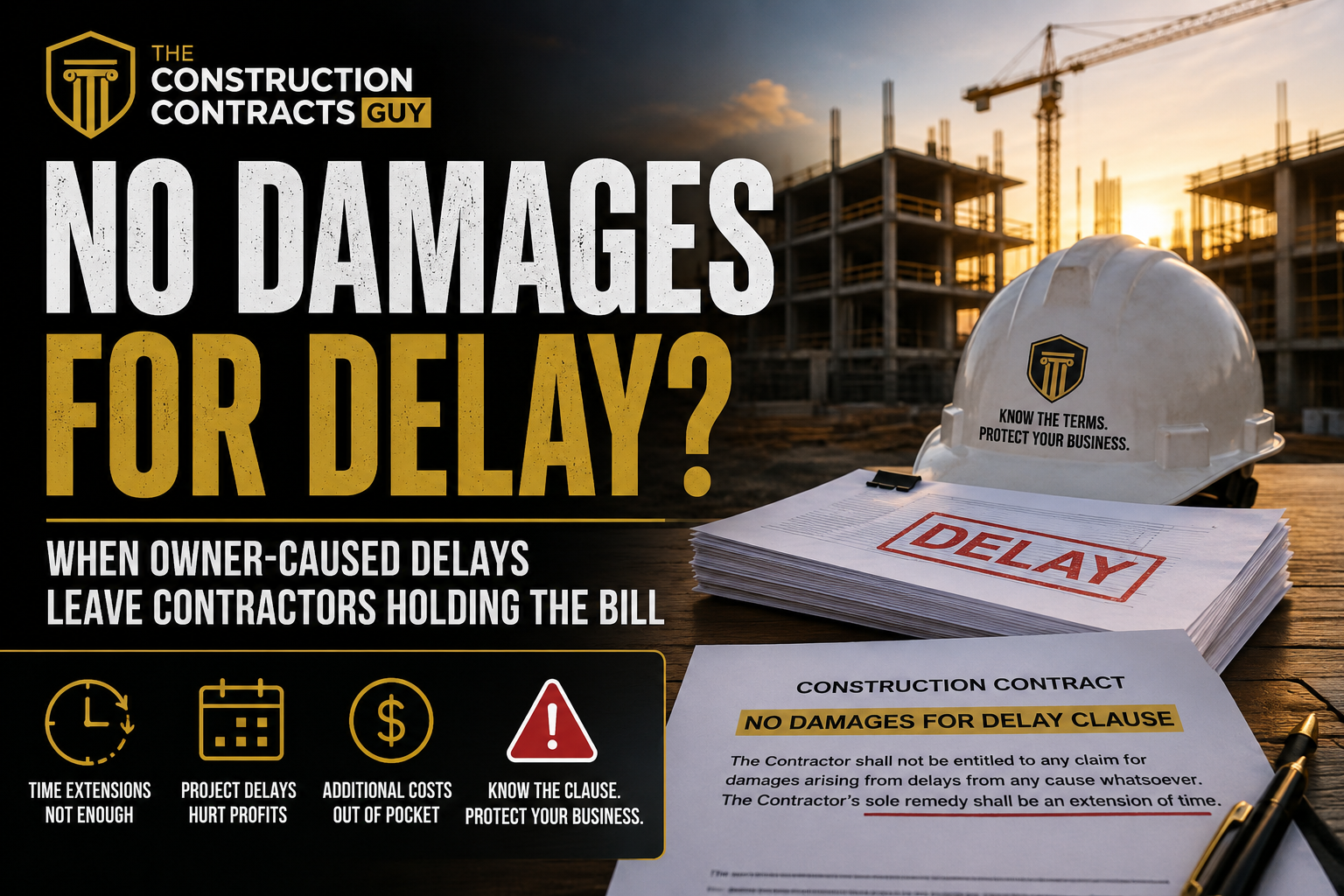
"The Contractor shall not be entitled to any claim for damages arising from delays from any cause whatsoever. The Contractor's sole remedy shall be an extension of time."
Some provisions apply only to specific categories of delay, while others attempt to eliminate virtually all delay-related damage claims.
The exact wording of the clause often becomes a central issue in litigation.
Are No-Damages-for-Delay Clauses Enforceable?
The answer depends on the applicable state law.
Many states generally enforce no-damages-for-delay clauses as valid contractual risk allocation provisions. However, courts have also developed several important exceptions that may allow contractors to recover damages despite the clause.
Common Exceptions to No-Damages-for-Delay Clauses
1. Active Interference by the Owner
One of the most widely recognized exceptions occurs when the owner actively interferes with the contractor's work.
Examples include:
- Refusing site access
- Directing work out of sequence
- Deliberately withholding approvals
- Intentionally obstructing performance
Courts often hold that parties cannot rely on a no-damages-for-delay clause to shield themselves from the consequences of their own misconduct.
2. Delays Not Contemplated by the Parties
Some courts refuse to enforce these clauses when the delay was far beyond what the parties reasonably anticipated when entering the contract.
Examples might include:
- Multi-year delays
- Complete project redesigns
- Significant scope restructuring
- Extraordinary scheduling disruptions
When delays fundamentally alter the nature of the project, courts may conclude the clause does not apply.
3. Abandonment of the Contract
Extremely lengthy delays can sometimes be treated as a practical abandonment of the project.
For example:
- Funding disappears
- Political disputes halt public projects
- Work is suspended indefinitely
In these situations, courts may determine that the original bargain no longer exists and refuse to enforce the clause.
4. Breach of a Fundamental Contract Obligation
Many jurisdictions recognize exceptions when the delay results from the owner's breach of a core contractual duty.
Examples include:
- Failure to provide plans and specifications
- Failure to coordinate multiple prime contractors
- Failure to provide access to the work area
- Failure to obtain required approvals
Courts may determine that no-damages-for-delay clauses were never intended to excuse material contractual breaches.
State Laws Restricting No-Damages-for-Delay Clauses
Several states have enacted statutes limiting or prohibiting no-damages-for-delay clauses, particularly on public projects.
Examples include:
- North Carolina
- Ohio
- Virginia
- Washington
Because these laws vary significantly by jurisdiction, contractors should always review the governing law provisions in their contracts and consult local counsel when evaluating delay-related claims.
Practical Tips for Contractors
Before signing a contract containing a no-damages-for-delay clause, contractors should consider:
Negotiate Exceptions
Attempt to carve out exceptions for:
- Owner-caused delays
- Design errors
- Delays exceeding a specified duration
- Material scope changes
Preserve Time Extension Rights
If damages are unavailable, extensions of time become critical.
Ensure the contract clearly outlines:
- Notice requirements
- Documentation requirements
- Time extension procedures
Maintain Detailed Records
Successful delay claims often depend on documentation.
Track:
- Daily reports
- Scheduling updates
- Correspondence
- Change directives
- Labor and equipment impacts
Proper documentation may ultimately determine whether an exception applies.
Practical Tips for Owners
Owners should remember that no-damages-for-delay clauses are not absolute shields against liability.
To improve enforceability:
- Draft clauses clearly and specifically
- Avoid conduct that could constitute active interference
- Maintain good faith project administration
- Coordinate project participants effectively
- Document scheduling decisions
Poor project management can create exceptions that defeat the very protections the clause was intended to provide.
Frequently Asked Questions
Can a contractor recover delay damages despite a no-damages-for-delay clause?
Yes. Many jurisdictions recognize exceptions involving active interference, bad faith, abandonment, fundamental breach, or delays not contemplated by the parties.
Do no-damages-for-delay clauses apply to subcontractors?
Often yes. Many subcontracts incorporate these provisions directly or flow them down from the prime contract.
Are no-damages-for-delay clauses enforceable in every state?
No. Several states restrict or prohibit these clauses in certain public or private construction contracts.
What is the contractor's remedy if the clause is enforceable?
Typically, the contractor's sole remedy is a time extension rather than monetary compensation.
Conclusion
No-damages-for-delay clauses are among the most significant risk-allocation provisions found in construction contracts. While they can provide owners with substantial protection against delay claims, courts and legislatures have imposed important limitations on their enforceability.
Contractors and subcontractors should carefully review these provisions before signing a contract, understand the governing state's legal framework, and maintain detailed records whenever delays occur. A clause that appears absolute on paper may not be enforceable when owner misconduct, fundamental breaches, or statutory protections come into play.
Understanding these provisions before a dispute arises can help avoid costly surprises when project delays inevitably occur.
Get the Free Construction Contract
Red Flags Checklist!